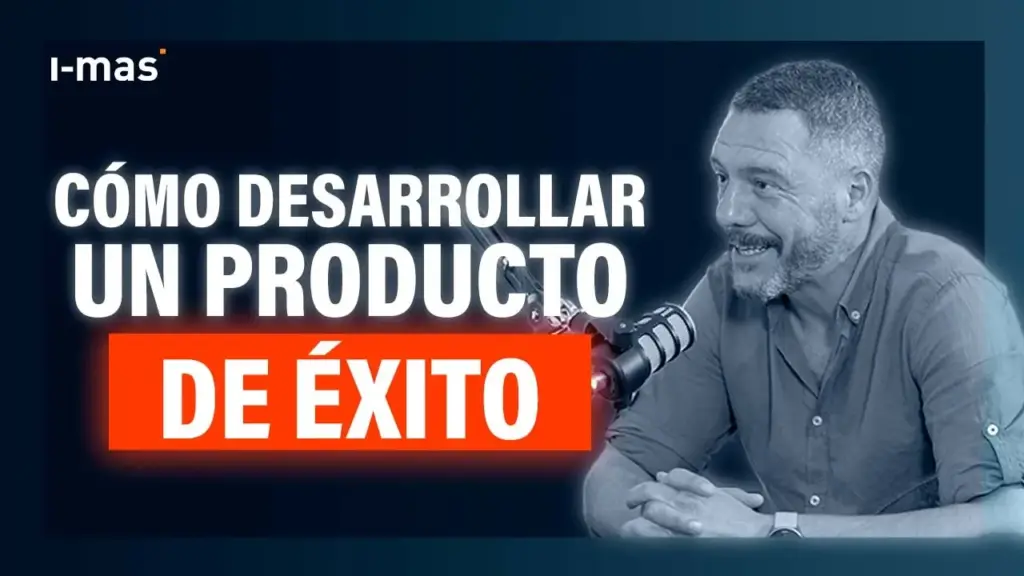
The product development phases connect a market need with a solution that can be manufactured and used. Quim Alcàntara, responsible for product design and development at i-mas, explains in chapter 17 of Toque de Ingenio how specifications, conceptual design, engineering, prototypes, and industrialization are linked. The interview provides the experience of the team involved in these real-world projects.
Guest Quim Alcàntara. Company or organization: i-mas.
Interview published: July 8, 2024. Episode: 17. Duration: 1 hour and 43 minutes.
In this episode:
- How to transform an idea or a brief into development requirements.
- Why design, engineering, and manufacturing should share common criteria from the outset.
- What is tested with prototypes, and what changes when preparing a series?
The starting point could be an idea or a defined brief.
Quim differentiates between entrepreneurs who arrive with an unmet need, and established companies that already understand their market, competition, and objectives. The support provided adapts depending on this starting point, but in both cases, it’s necessary to clearly define the work involved.
The initial review examines the project and the state of the art. It’s about understanding the problem, the alternatives, and the necessary capabilities. This information helps to transform a general intention into a scope that the team can develop.
The specifications phase allows for agreement on functions and limitations. The document should facilitate decision-making: what the product needs to achieve, what conditions are important, and what priorities guide the design. An ambiguous description can lead to uncertainty, making revisions more costly later on.
The conceptual design should be able to be transformed into a finished product.
Quim explores the evolution of presentation tools, from initial sketches to detailed models and renderings. The key isn’t the specific tool used, but rather whether the concept is clearly understood and maintains a realistic connection with subsequent development.
The interview stresses the importance of avoiding a significant disconnect between the presented image and what can be realistically produced. Design and feasibility need to work together from the initial concepts. Decisions regarding form will impact components, assembly, and the overall user experience.
In i-mas, the product design and development Bring together the relationship between appearance, function, and manufacturing. A conceptual proposal should establish a technical pathway that the team can explain and compare.
Engineering details how the whole system will function.
Once the direction has been chosen, the development team works on creating the components, mechanisms, and integration. The specific disciplines involved depend on the project – this may include mechanical design, electronics, and software, alongside specialists in manufacturing.
Regular meetings with clients help to keep decisions aligned. Quim explains the usefulness of scheduling regular meetings to coordinate people and prevent the agenda from delaying the project. Organization also plays a role in ensuring the project’s continuity.
When the product incorporates control or connectivity, the custom electronics It requires shared requirements with the rest. Component placement, power supply, and interaction shouldn’t be treated as separate tasks.
The product development phases include iteration.
Quim explains that after a prototype is created, there are improvements and adjustments made. The number of iterations depends on the difficulty of the project and what the tests reveal. It’s impossible to define all the necessary corrections precisely before observing how it functions.
“There’s always a stage of improvements and refinements”.
Quim Alcàntara 19:20.
The conversation outlines a complete prototype for testing individual components or subsets. A product may require several partial checks before being assembled. Simply counting complete units doesn’t reflect the entirety of the validation process.
Los functional prototypes They must answer a specific question. Verifying a dosage, a joining, or a route allows you to determine what to retain and what to modify. The test proves useful when its conclusions relate back to the design.
Preparing the setup changes details that had seemed minor.
Quim uses fasteners as a design example for assembly. Reducing tools or standardizing components can simplify repetitive operations, provided the product allows for it. A small detail becomes significant when something is assembled repeatedly.
“Standardize the fasteners”.
Quim Alcàntara 24:39.
The interview also explains that the concept of “short series” depends on the type of equipment involved. The volume of a consumer product cannot be directly compared to that of specialized equipment. The manufacturing strategy must adapt to these conditions.
El industrial assembly Early versions of the process help to connect documentation, components, and operations. This is a stage where it’s checked whether the development decisions allow for consistent reproduction of the results.
UX/UI: to design how the product is understood and used.
Quim defines the user experience as the relationship between the person and the product. The interface is part of that relationship, particularly when there are screens and navigation. The clarity of the actions is just as important as the visual appearance.
A coffee machine provides a useful example: choosing a drink requires a sequence that is easy to understand. Images, options and navigation must support actual use as well as an attractive layout.
El UX/UI design It can support both physical and digital development. Coordination prevents a well-executed function from becoming difficult to find or use.
Connecting the target cost with the market proposal.
The interview also addresses the price and accumulated effort throughout the project. Quim recalls that the development cost, on its own, does not determine what the market will be willing to pay.
Defining a target cost is essential for guiding materials, components, and processes. It’s also important to understand the channel through which the product will reach the buyer. The design process should consider these conditions before the key decisions are finalized.
The complete process, therefore, involves a coordination of technical and commercial decisions. Each phase provides information for the next, and may necessitate revising a previous hypothesis.
Questions about product development stages
What are the main stages of product development?
The interview covers analysis and specifications, conceptual design, technical development, prototypes, improvements, and industrialization. The scope of each phase depends on the product and its starting point.
How many prototypes does a product need?
There is no universal figure. Quim distinguishes between testing individual parts and complete assemblies; the number depends on the complexity and what needs to be checked.
When should one consider the manufacturing process?
From the initial proposals, the choice of materials, components, assembly methods, and the target cost all influence decisions, which become increasingly difficult to alter later on.
Four key takeaways from the chapter.
- Specifications transform an idea into a shared scope.
- The conceptual design should maintain a connection with the manufacturing process.
- Prototypes allow us to learn and refine the development process.
- Industrialization connects components, assembly, controls, and volume.
From learning to product development.
If you need to develop a product, i-mas can support you from defining requirements through to preparing for manufacturing. We integrate design, engineering, electronics, prototyping, and assembly, all tailored to the specific needs of your project. Let’s talk about your starting point..
You can also read. The development of Citring One.
Source: Original interview from Toque de Ingenio, published on YouTube on July 8, 2024. The experiences, figures, and plans discussed in the interview are reflective of that specific time. The references to i-mas services are the editorial analysis of the article.