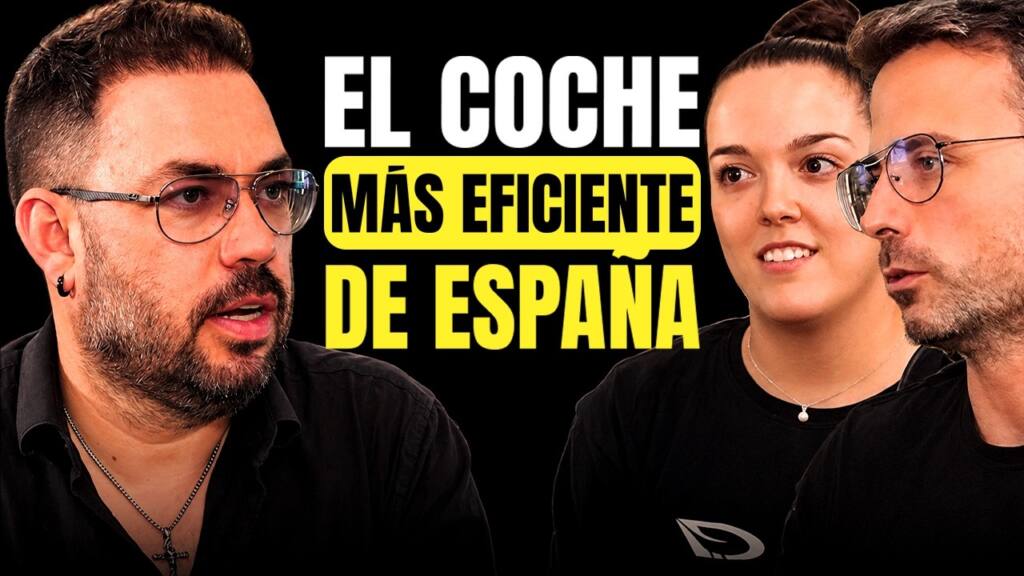
A road car driven very carefully does about 18 or 20 kilometres on a litre of petrol. The Dátil does 1,829. That is the distance from Barcelona to Warsaw, covered on less than two euros of fuel, and no manufacturer has achieved it: students at the Universidad Miguel Hernández de Elche have, with a 30-kilo carbon fibre prototype shaped like a water drop.
With that mark, Dátil UMH Team has just finished runner-up for Europe and Africa at the Shell Eco-marathon, the best-known efficiency competition in the world, only 20 kilometres behind first place. In this episode of Toque de Ingenio the story is told by David Abellán, lecturer in mechanical engineering at UMH and team coordinator, and Lucía Muñoz, mechanical engineering student and captain of the Dátil.
Guests: David Abellán, lecturer in mechanical engineering at Universidad Miguel Hernández and coordinator of Dátil UMH Team, and Lucía Muñoz, mechanical engineering student and team captain. Conversation published: 30 September 2026. Running time: 1 h 10 min.
In this episode:
- Why this race is won by the car that consumes least, not the fastest one.
- How you measure efficiency with no wind tunnel and no budget.
- What an engineering student learns by building a car nobody would ever manufacture.
A race won by whoever consumes least
The Shell Eco-marathon does not reward speed. Teams complete seven laps of a motor racing circuit —around 10 kilometres in total— and the winner is whoever has burnt the least fuel by the end. To stop everyone from crawling round at idle, the organisers impose a minimum average speed of 25 km/h and a maximum time: miss that window and the attempt does not count. Each team gets six attempts.
Fuel measurement is strikingly simple. The tank is a 30-millilitre laboratory flask supplied by the organisers, transparent and filled with dyed fuel —the dye changes every year— so that nothing can be added. It is weighed before and after the run, and the equivalent distance per litre is calculated from the difference. The vehicle’s electrical consumption is also measured, with a joulemeter, then converted and deducted from the final result.
That detail explains why historical marks are not comparable. The team record is 2,100 kilometres, set in 2019, when electrical consumption was not yet counted and on a different circuit. The venue changes every year, and so do the conditions: the only valid comparison is against the other teams in the same year. This year there were 150 teams from 27 countries, in Poland.
A car that starts, switches off and coasts
The Dátil competes in the prototype category, where vehicles are optimised to the limit: anything that can be removed is removed. It has three wheels —two at the back, one at the front—, front steering made mandatory after several accidents, and a driver who lies completely flat and watches the track between her own feet through a small window. The steering wheel does not turn: it slides sideways.
The least intuitive part is how it is driven. The engine does not run continuously: the team accelerates up to a given speed, switches the engine off completely and lets the car coast until it drops below a certain threshold, then starts it again. One or two restarts per lap, depending on strategy. With a vehicle that weighs almost nothing, a single burst of acceleration can cover a whole circuit.
And there is an implicit rule that shapes everything else: braking means losing. If the driver has to brake because of traffic —there can be twenty or thirty cars on track at once—, that attempt is written off. Which is why driving strategy, the moment you go out, and even hugging a wall to cut the wind are all part of the engineering work.
The engine: from a brushcutter to an in-house design
The team started with a Honda GX25, a garden tool engine with a carburettor. In 2010 they took the leap and designed their own four-stroke engine, conceived from scratch for the competition: a far higher compression ratio than a conventional engine, a long stroke and every parameter adjustable. And, above all, electronic injection, which David points to as one of the improvements that cut consumption the most.
They run on ethanol rather than petrol for a technical reason: its higher octane rating allows a higher compression ratio and therefore better efficiency. Since then the work has not been redesigning but fine-tuning: settings, ignition, valve timing, how much is injected at each point. Years of iteration on the same base.
That is an important difference from other university competitions: here the car is not built from scratch every season. It lets the team accumulate knowledge, but it also shifts the challenge. As Lucía admits, the car is now so refined that the job is to modify and solve, not to design from a blank page.
Measuring without a wind tunnel: slingshots, pendulums and slopes
The most instructive part of the episode for any development team is how they validate without access to industrial facilities. Aerodynamics are worked out with computational fluid dynamics (CFD) before the body is manufactured, using the software the university licenses for teaching and research. The engine is tuned on their own dynamometer.
But rolling resistance, where they have struggled most this year, is measured with homemade rigs. They have launched the car with a sort of slingshot down the hall of the building —always the same initial energy— to see how far it travels. They have put the car on a downhill slope next to another vehicle to see which one pulls ahead with no engine. And they have built a pendulum on two wheels: they set it swinging, measure how the oscillation decays and estimate rolling resistance from that, which lets them compare pressures, rim widths and tyre models.
That work became urgent when the organisers banned the tyre they had been using for years. Michelin had developed a model for the competition that was far better than the rest and then stopped making it; over time, the race was turning into a competition to hoard stock of that tyre. Banning it levelled the field and forced everyone to start testing from scratch.
The year the steering wheel broke
Asked about the biggest technical challenge of her five years with the team, Lucía does not mention a simulation or a calculation:
«During the race we broke the steering wheel and had to build a new one in an hour so we could go back out on track».
Lucía Muñoz, 53:44.
The wheel was integral to the steering, so the fix also had to be approved by the organisers before they could go out. They finished fifth. Her other contribution, the one she is proudest of, sounds just as unglamorous and is just as revealing: getting the car to brake properly. It had not done so for a long time, and it is where she has put in the most hours.
What you learn by building a car like this
David has been involved with the project for 17 years. It started in 2004, driven by lecturer Miguel Ángel Oliva. He has seen many intakes come and go and has a clear reading of what it gives them:
«There is a lot of blank page, a lot of facing problems you did not expect, a lot of real engineering challenge. And that is valued».
David Abellán, 1:02:11.
He also points to a generational shift: many students now do work placements in industry from their first years, and a project like this demands a commitment that is hard to fit in. Without a group able to sustain long hours for one or two years, building a complete car stops being viable.
The team is now preparing its next target: it has qualified for a competition in Qatar among the 18 best teams in the world, and is looking for sponsors to get there.
What another development team can learn
Beyond the competition, the Dátil case offers lessons that apply to any project under hard constraints:
- Defining the metric properly changes the design. Optimising for consumption instead of speed leads to a vehicle no manufacturer would ever build: three wheels, 30 kilos and the engine switched off most of the time.
- Measuring badly is worse than not measuring. A well-conceived homemade pendulum gives comparable data; the key is not expensive equipment but a repeatable test.
- Capitalise on previous work. Not redesigning the car every year allows years of fine-tuning on the same base, which is where the last tenths of performance live.
- What fails in the race is not what worried you at the desk. A broken steering wheel or a brake that does not respond decides a season as much as aerodynamics do.
From prototype to production, at i-mas
The Dátil is an extreme version of something we do every day: taking an idea to an object that works, measuring it and improving it with the resources available. At i-mas we approach product design and development end to end, from prototyping through to production and assembly, with mechanics, electronics, software and industrial design under one engineering roof.
If your project needs to move from prototype to production, tell us about it.
Further reading: how ESEA Propulsion designed an electric outboard motor from scratch.
Source: interview by Edgar Guerrero with David Abellán and Lucía Muñoz on Toque de Ingenio. The quoted passages link to the exact minute of the conversation. The recommendations for other projects are an editorial synthesis by i-mas.