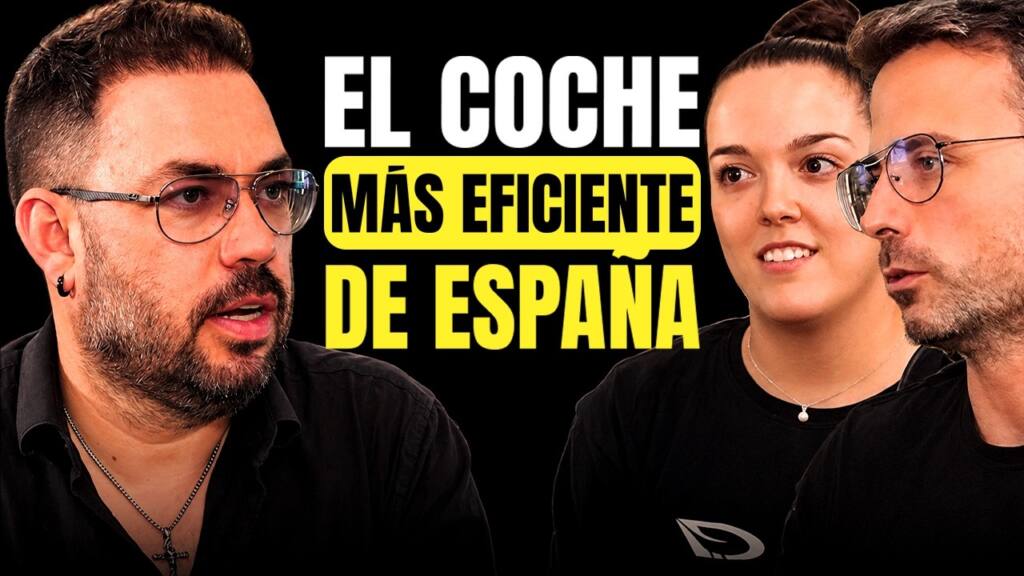
Measuring the bar’s speed allows you to assess performance and fatigue during strength training, without requiring maximal tests or subjective feelings. Vitruve transformed this principle into a wireless encoder connected to a mobile app – ten times cheaper than equipment from 2015. In chapter 84 of “Toque de Ingenio,” Óscar Repiso explains how they evolved from a cardboard and Arduino prototype to a product now used by clubs and universities, and the key decisions made in terms of manufacturing, validation, and business strategy.
Guest: Óscar Repiso, who was introduced in the episode as co-founder and CEO of Vitruve. Interview published: September 1, 2026. Episode: 84. Duration: 1 h 18 min.
In this episode:
- Why the rate of bar progression is replacing the maximum repetition as a measure of performance.
- How the first 3D printers were manufactured, and what went wrong with the initial production run.
- What changes when a client transitions from being a fan to becoming a professional club?
The conversation was recorded during the summer of 2026, following Óscar’s visit to i-mas’ facilities, at a time when Vitruve was developing a product to measure sprints and was shifting their catalogue towards clubs.
Speed-based training: the science behind the product.
Óscar describes how strength training was planned without technology: relying on the coach’s keen eye and the athlete’s perceived effort. He explains that many people program their routines based on percentages of a maximum weight they’ve never attempted to lift.
An alternative approach is speed-based training, primarily researched by Spanish experts. Óscar cites Juan José González Badillo, who observed that using weights below maximum capacity predicted the daily record in weightlifting. Subsequently, a near-linear relationship was found between speed and load, and also between the decrease in speed during a set and fatigue measured by lactate levels.
All of this stems from those two principles. With a comfortable load, it’s possible to determine if today’s weight is 10% lower than yesterday’s and to adjust accordingly. Óscar clarifies a limit: the linearity is very high within a single individual; when working with groups, it’s necessary to use population averages or a specific load-velocity profile. For a footballer, Óscar believes that aiming for the maximum repetition in a squat is, in terms of gym exercise, the most damaging activity to obtain a precise data point.
A cardboard prototype and a shared 3D printer.
In 2015, the devices that measured this cost around €3,000 and were connected to a computer via cable. Óscar and his partner, Iker, who had been friends since childhood, learned about them through an educator who convinced them that without this data, they were training blindly. They were both 22 years old.
Iker, an electronics and automation engineer, built the first encoder using a cardboard box, a laser, and an Arduino. It was already displaying speeds. The second version replaced the homemade disc with a commercial encoder and aimed to find a casing where all the components would fit.
They discovered 3D printing there. Óscar’s university only had one printer, so every week they would give a USB drive to the janitor and collect the finished piece in the afternoon. The process was incredibly slow – the covers wouldn’t fit, the encoder wouldn’t go in. Meanwhile, Óscar was developing an Android app that displayed the repetitions in a graph. They went through months like that until it was demonstrated in powerlifting groups and people started requesting units.
Making at home: silicone molds, printers, and a kitchen.
The initial attempts at production involved homemade silicone molds. Óscar recounts that a vacuum chamber was built using a slow cooker and a refrigerator pump. While the finish was smooth, the pieces had thin walls, often contained bubbles, and weren’t designed for easy removal from the molds. This method wasn’t suitable for large-scale production.
They then bought five or six inexpensive 3D printers. They sanded and painted each piece to make it look like injection-molded plastic, and set up sales on Instagram under the name “Speed4Lifts” at €189. Without a website or shop, they received over 300 orders.
“Today’s minimum viable product has 10 times the quality it had back then.”
Óscar Repiso 32:53.
The first office was his grandmother’s house, with the printers running around the clock in the kitchen, and friends assembling units in the living room. The retractable cable reel was made from dismantled measuring tapes. Óscar admits that this product wouldn’t be sold today, but it was ten times cheaper, without cables, and with mobile functionality.
This excerpt demonstrates what it enables. prototyping Without a budget: check demand before investing in equipment. And also, determine your limit.
The initial roll resulted in a 20% failure rate: we need to redesign the core and move to an injection method.
That limit appeared in the first large series. The initial units hadn’t failed, but when the volume was multiplied, the inner shaft where the spring attaches began to crack.
“When we did the first run of around 200-300, 20% of them broke, the axles snapped”.
Óscar Repiso 41:16.
The reason was the process: a printed piece, layered and resistant to crushing, but not torsion. The second version involved injecting the axis and outer casing, while the interior remained 3D printed for years because it had been designed without mold considerations. They added a screen with buttons, requested by users, and a Chinese company delivered the pre-manufactured boards.
Finding someone to assemble the product presented another challenge, as no production line was prepared to handle such low volumes: in the first year, they generated around €40,000, and in the second year, between €80,000 and €90,000. The turning point came when one assembly line agreed to dedicate a few hours per week to them, and they’ve continued with that arrangement.
For a team of product design and development, This case illustrates two key decisions: which critical components should be changed in the process before scaling, and how to secure a partner. production and assembly from small volumes
Validate the data: profile load-speed, fatigue, and force plates.
In the interview, Óscar demonstrates the device. It’s attached to the ground, the cable is connected to the bar, and each repetition provides speed and an estimated maximum. With 82 kilos and a first repetition at 1.14 m/s, the application calculates a maximum of 170 kilos.
The coach can set a permissible speed reduction, for example, 10% before a match, or 25% to stimulate hypertrophy. The app will alert them when that threshold is reached. It also allows programming by speed ranges, so the weight for the session is automatically adjusted during warm-up.
The current proposal involves an ecosystem where the coach plans, executes, and analyzes – all within a single software platform – and is integrated with sleep and recovery wristbands. According to Óscar, these wristbands predict what a person is capable of, while the encoder shows what they actually do.
The vertical jump, measured using a harness, has been calibrated in a sports science laboratory using platforms costing between €15,000 and €20,000, achieving a 97 or 98% accuracy rate. The subsequent product – time gates incorporating lidar for sprints and reaction time – replaces four photocells with two devices.
From fan to club: price, software, and distributors
Vitruve began by selling to individuals for under €200. Óscar explains that the company has decided to focus solely on B2B, targeting sports clubs of all types. This isn’t a massive market, so they need higher-priced tickets, and the price increase is concentrated on the recurring software.
Stanford’s example illustrates this: 400 athletes using approximately twenty devices, one per rack. They charge for the data and the integrations.
Most of our major clients have come through organic means. Other clients have arrived thanks to sports equipment distributors, who introduced our product to Real Madrid, and who explain that Japan is the third-largest market for us.
The episode resulted in two key management warnings. Without a shareholder agreement, the departure of a third founder forced a buy-back when no one was receiving a salary. And following the final funding round in 2022, the rush to hire led to a third of the money being wasted on a project that had to be abandoned.
What can another development team learn?
The Vitruve case offers valuable lessons for any product with sensors and an application.
- Relying on published scientific research. The value of the encoder isn’t in inventing a principle, but in making a validated measure accessible.
- Replace the faulty parts with new ones. A larger batch reveals flaws that aren’t visible in ten individual units; the injection axis resolved what printing couldn’t.
- Check against the reference pattern. Comparing the jump with strength platforms provides verifiable data that can be presented to a club.
- Deciding who to sell to before setting the price. The same hardware can support either a consumer-oriented model or a B2B model, but the software and distribution channels differ.
At the time of the interview, Vitruve’s primary market is the United States, and they are preparing to launch their time doors for sprints, increasingly focused on clubs and universities.
At i-mas, we develop products that combine sensors, electronics, mechanics, and application, and we prepare the transition from initial units to mass production. If your project needs to move from prototype to series production, Tell us about your project..
To continue reading: How to plan the transition from prototype to manufacturing..
Source of article: An interview with Edgar Guerrero by Óscar Repiso on Toque de Ingenio. The excerpts cited link to the minute of the conversation. The recommendations for other projects are a summarised editorial from i-mas.