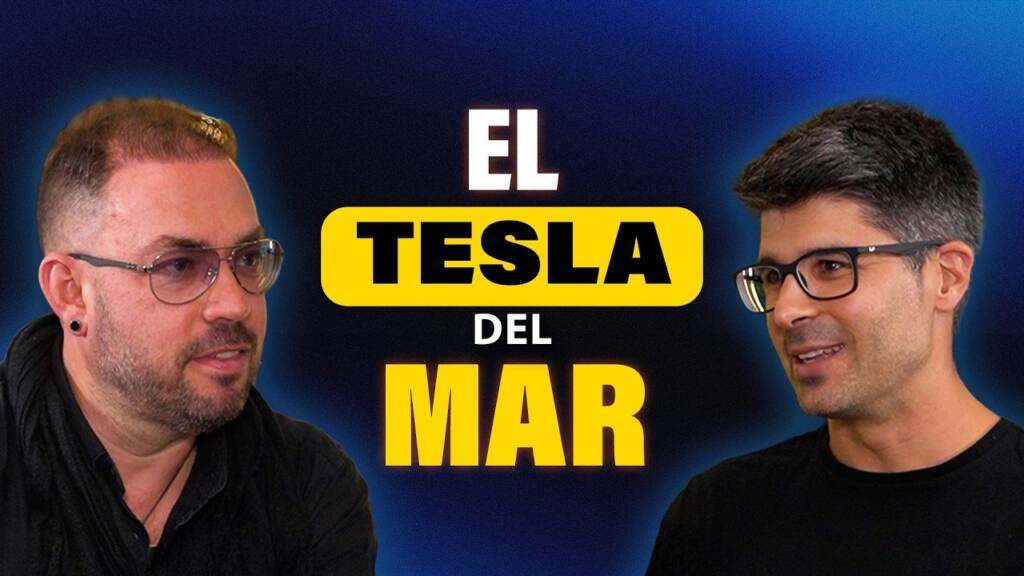
An electric outboard motor doesn’t necessarily have to resemble a combustion engine one. ESEA Propulsion, a startup based in Menorca, has patented a system that distributes the mechanics horizontally, freeing up the stern and simplifying the boatbuilder’s work. In chapter 65 of “Toque de Ingenio,” Carlos Puerta explains what it means to “marinize” an electric system, how to calculate the actual range of a boat, and the path taken by a prototype funded by the PERTE naval program.
Guest: Carlos Puerta, who was introduced in the episode as a co-founder of ESEA Propulsion. Interview published: October 21, 2025. Episode: 65. Duration: 1 h 6 min.
In this episode:
- Why the team scrapped the “refit” and instead started with a blank slate.
- What does protecting batteries, the motor, and connections from saltwater involve?
- How the first prototype was tested, and what’s still needed to reach shipbuilding.
The conversation was recorded in Barcelona during the Boat Show week, which Carlos used as an opportunity to travel from Menorca. The team had just tested their first prototype at sea and were preparing for a second round of funding.
Design an outboard electric motor, starting from scratch, rather than adapting an existing combustion engine.
Carlos worked for Seat for approximately ten years, within the Volkswagen group, and experienced the strategic shift that followed the “Dieselgate” scandal in 2015. He recounts that the initial electric vehicles from major brands were “refurbished” models – existing cars where the combustion engine was removed and batteries were installed. The e-Golf was more expensive than a gasoline-powered Golf with around 200 km of range, and it sold poorly.
The alternative was to develop platforms designed to be electric, as Tesla did, and later Volkswagen with its ID models. That’s the comparison ESEA Propulsion applied to the nautical sector. The electric outboard motors presented today, Carlos explains, maintain the architecture of a traditional Yamaha: the combustion block is replaced with a motor, an inverter, and a control unit, and the housing is changed.
ESEA’s design starts with a different question: how much space does an electric propulsion unit really need, and where should it be positioned? This approach led to the patent.
“Instead of growing in potential upwards, we are growing outwards”.
Carlos Puerta 17:44.
Growing horizontally: what does this patented architecture solve?
A conventional pod concentrates the engine above, widening the strut in the middle section. When the system is arranged horizontally, between the waterline and the sheerline, the mechanics become more compact, the stern gains efficiency, and the power-to-weight ratio improves.
The third advantage is the most important for shipowners: when the engine is removed and taken out of the water, it doesn’t encroach on the stern. Carlos cites De Antonio Yachts, who are already integrating the outboard motors into the structure to look towards the stern without obstruction.
For those sailing, the result is increased comfort: the ability to shower from the stern without maneuvering around a 100-horsepower engine, as well as the absence of fumes and noise.
The system is designed for boats ranging from 4 to 12 meters in length. The initial engine is 100 horsepower, equivalent to 75 kW continuous, and the current plan, at the time of the interview, was to upgrade to versions with 50 and 200 horsepower. When mounted in pairs, the power is doubled.
The company began in 2021, received the highest valuation from the European Patent Office, and filed for patents in the United States, Japan, and China. Carlos reports that its main competitor, a British company, attempted to register a similar patent just one month later, but the application was rejected.
Marinating an electrical system: batteries, sealing, and biases.
Edgar’s concern is a common one: electricity, water, and saltwater don’t seem like a good combination. Carlos responds by citing the example of electric cars in flooded areas, where the batteries are isolated with IP67 or IP68 protection and can be submerged for a few minutes.
“Marinization” involves applying this approach to the entire system: using silicone seals and tested components resistant to saltwater. The charging connections in the port are also protected, and if a cable falls into the water, the fuses will trip, isolating the hull.
La Electronic engineering Marina has a particularly vulnerable area. The batteries are housed within the hull, sealed and protected, while a submerged motor – similar to that found in small outboard motors – is permanently exposed and degrades much more rapidly.
“If your electric motor is so exposed, you really need to do a thorough job of marine-proofing it”.
Carlos Puerta 56:18.
Autonomy: studying actual usage before providing a figure.
The question Carlos receives most often is how far the boat can travel. His answer is that it depends on the battery, the type of hull, and whether the navigation is displacement-oriented or demanding. He warns that giving a number without that context ultimately limits the product’s potential.
What it does offer is a useful piece of information. According to a study cited by the guest, tourists who rent a boat for one day typically don’t travel more than 15 or 18 miles. ESEA’s calculations indicate an autonomy of over 20 miles for a charter day, ranging from 20 to 40 miles depending on the situation.
For other applications, the team was working on a hybrid option with a small range extender, similar to what’s used in the automotive industry. The control unit can also manage the delivery: if the user navigates at 30 knots for the first half of the battery, it will then limit the power to ensure a safe return.
Carlos places this in the context of increasing regulation. He says the Mediterranean, with 27% of global nautical tourism, is already an emissions control area, and cites 200 lakes with restrictions on combustion engines. A petrol outboard motor, he adds, can emit up to 130 times more particles than a car of the same power.
From the PERTE shipbuilding plan to the first prototype tested at sea.
The project began between three childhood friends around 2019 and 2020. One brought nautical expertise as a naval mechanic teacher; another, fifteen years of entrepreneurship; and Carlos, his knowledge of automotive electrification. In 2022, he dedicated himself fully to the project.
To avoid losing momentum, they sought public funding and secured the PERTE naval – a grant from the Ministry with European funds covering between 60% and 70% of the R&D costs. With this, and in collaboration with Tecnalia in electromobility, they built a single prototype Integrated into an electric boat, approximately 5.5 meters long.
The tests were conducted at sea, in Menorca, and in Bilbao. According to Carlos, the onboard sensor system indicates what has worked, what needs to be preserved, and what needs to be revised. The next step is to redesign that prototype to make it more robust and to present it to shipyards.
At the time of the interview, the schedule was to present the evolved prototype in a real-world environment, alongside stress testing and certification. Carlos also highlights the support of ParcBit, a Balearic initiative that incubates startups and connects them with investors. Essentially, innovating from an island requires patience and leveraging the expertise of those who can provide it.
Shipyards as the initial client and competing with Yamaha or Mercury.
Edgar raises the logical question: to sell a motor to a shipyard, a standardized and certified industrial product is required. Carlos clarifies that they initially want to provide sensorized proof-of-concept demonstrations to shipyards in the Netherlands, Belgium, and Spain: ESEA will gather data to update the hardware, and the shipyard will showcase something that is not yet commercially available.
The initial client is a shipbuilder who wants to electrify a section of their vessels, utilizing a new bow thruster. They are considering online sales and refit services, and are working with a full-service yacht designer specializing in distribution across the Caribbean and Central America.
Major manufacturers are already taking action: Yamaha has acquired Torqeedo, and Mercury has launched the Avator line, with approximately 10 horsepower models. Yamaha also has the Harmo, a low-power auxiliary with an underwater motor.
At the METS trade show in Amsterdam last year, 80% of the exhibition space was occupied by electrical devices. ESEA presented a scale model at a modest stand and received visits from distributors from the United States and Turkey, as well as two engineers from Yamaha who spent two hours photographing the project.
What can another development team learn?
The ESEA Propulsion case offers four key lessons applicable to other products that electrify existing systems:
- Questioning inherited architecture. Changing the motor without rethinking volume and distribution wastes the main advantage of electrification.
- Design for the integrator. Solving the shipyard’s problems related to engine installation transforms a technical advantage into a commercial argument.
- Measure actual usage before promising autonomy. A case study approach provides a more precise specification than a single, isolated figure.
- To set up the initial prototype. The sensor data from sea trials determines what is retained and what needs to be redesigned in the next iteration.
At the time of the interview, ESEA Propulsion held a granted patent in Europe, a prototype that had been tested at sea, and a second round of funding that they hoped to secure before the end of the year, compatible with a participatory credit scheme.
In i-mas, we accompany product design and development This involves combining mechanical, electronic, and prototyping elements before moving towards industrialization. If you’re electrifying a system or preparing a prototype for real-world use, Tell us about your project..
To continue reading: How did an automatic pilot system for boats, integrated into the steering wheel, come to be developed?.
Source of article: Interview with Edgar Guerrero and Carlos Puerta on “Toque de Ingenio”. The excerpts cited link to the minute of the conversation. The recommendations for other projects are a summarised editorial from i-mas.