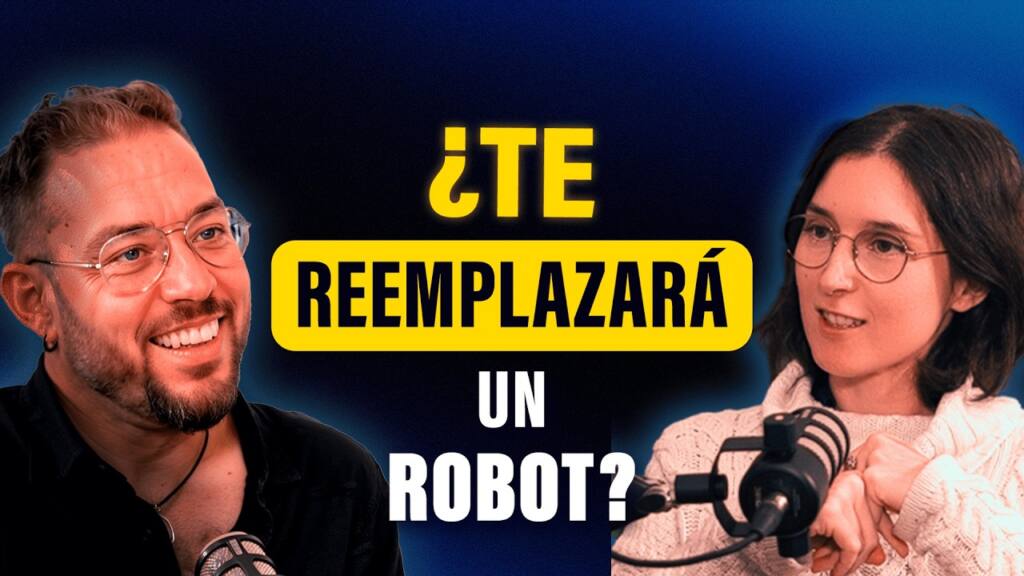
Automating picking involves combining product detection, grasping, and movement with its integration into warehouse workflows. The challenge increases when the size, material, or presentation of the items change. In Chapter 34 of “Toque de Ingenio,” Andrea Inglés, CEO and co-founder of Illumo Robotics, explains during the interview, what robotic picking needs to fit into a client’s operations and how to assess its productivity.
Guest: Andrea Inglés, who was introduced in the episode as CEO and co-founder of Illumo Robotics. Interview published: January 20, 2025. Episode: 34. Duration: 1 h 20 min.
In this episode:
- What product differences should a robotic picking system address?
- How to coordinate machine vision, grasping, order identification, and order flow.
- What to measure before comparing a manual operation with an automated one.
The conversation covers a period where Illumo was reviewing how to make their solution more repeatable and expand its application. The evolution proposals shared by Andrea relate to that stage of the project.
Robotic picking and bin sorting: handling variable products.
In an industrial process with well-defined parts, it’s possible to study their dimensions, materials, and typical positions. However, an e-commerce warehouse can present a much more variable situation: items such as clothing, toys, accessories, DIY products, and goods with different packaging.
Andrea describes this diversity as one of the main challenges in robotic picking. The robot needs to locate an object, decide how to pick it up and move it correctly. The difficulty changes if the product reflects light, has a difficult surface to perceive, or arrives partially hidden by other items.
The episode discusses bin picking, The extraction of items from a box or a defined space. In the example given, the immediate objective is to remove the products one by one and place them on a conveyor belt so that they can continue their journey.
The selection of cameras, handling tools, and manipulation strategies must be adapted to that diversity. The value of the system depends on how effectively it addresses the cases that arise during the operation, including those that deviate from the ideal conditions of a demonstration.
Integrating picking into the entire warehouse process.
One of the most important ideas presented in the interview emerges when Andrea shifts the focus from the robot to the warehouse. The client requires that products move through their process, be correctly identified, and arrive at the appropriate destination.
“The client needs you to completely resolve their entire system”.
Andrea Ingles 06:25.
In the solution described during the episode, the arm places the items on a tape. Subsequent operations then take place: verifying that only one unit has been deposited, scanning the product, labeling it when appropriate, and directing it to the next stage according to the warehouse system’s instructions.
That destination can vary. Some products follow an automated packaging route; others need to be grouped together with other items from the same order, or they may require a manual operation. The system needs to understand and respect these routes.
Therefore, defining a project involving Automation It requires defining what comes in, what goes out, how information is exchanged, and how errors are detected. A correct extraction loses its value if the article is misidentified or disrupts the subsequent flow.
How to assess productivity before automating.
Andrea insists on a difficulty that arises before selecting the robot: the precise understanding of how the task is actually performed. The project manager, the operational team, and the person working in the role may all have different information about the same process.
The estimated productivity figures don’t always capture what’s happening during a workday. There are movements, minor issues, changes in product mixes and operations that go unnoticed until someone observes the work closely.
Because of this, in the discussion, it’s proposed to dedicate time to carrying out and measuring the task manually. This observation allows us to identify steps, compare timings, and discover conditions that should be part of the solution.
For a company considering automation, the approach is straightforward: before promising an improvement, it’s advisable to agree on how the starting point will be measured. The comparison should relate to the same task and include all the necessary operations to complete it.
Ergonomics also features in the episode. Andrea describes workstations that require people to bend over boxes or repeat movements for many hours. Understanding these conditions helps to identify which aspects of the work should be transformed and how to organize the interaction between people and the automated system.
Automation of picking: productivity depends on integration.
When discussing speed, the interview offers a particularly valuable insight. The improvement doesn’t simply come from making a single arm move faster. It also depends on how the workload is distributed between the robot and the rest of the team.
A person can pick up an object, identify it, label it, and then place it in its designated location, all in a sequence. Within the process described by Andrea, the arm focuses on the action of extracting and depositing, while other operations are carried out afterward in the line.
“You win the speed because you’re so well integrated”.
Andrea Ingles 56:25.
This explanation changes the way a robotic cell is evaluated. The movement time is important, but so is the presentation of the boxes, the reliability of detection, the separation of items, and the capacity of the stations that follow the robot.
To evaluate a productivity improvement, it’s necessary to consider the product, the task, the integration, and the operating conditions that have been agreed upon and verified. This evaluation allows for the setting of objectives linked to the specific operation.
The balance between a repeatable solution and a different repository.
Illumo experiences a recurring tension during its development – a need to create a solution that is both repeatable and capable of serving clients with diverse processes.
Andrea explains that some warehouses present items in boxes, others use carts or shelves, and still others have different space layouts. The way items are presented and the connection to the management software also vary. Each of these particularities can add complexity to the installation process.
At the time of the interview, the team was examining a proposal involving the combination of existing modules and solutions to address various needs. Andrea used the example of setting up a kitchen – starting with a space and a catalog to organize elements in a coherent way.
The comparison allows us to visualize an important concept. Repeatability requires clear boundaries: what formats are accepted, what variations the system can handle, and which cases require specific development. Defining these limits makes it easier to budget, test, and implement, ensuring a clear and understandable scope for both parties.
In projects of Machine vision and robotics, Defining the scope of applications also helps in determining which examples should be included in testing. A solution designed for a specific product family should demonstrate its behavior within that scope before expanding expectations.
Robotics as a service: also considering the economic viability.
The conversation focuses on robotics as a service model, where the provider contributes to the initial investment, and the economic relationship is linked to the use of the technology or the service provided. This approach can make the technology more accessible to clients, but it requires examining how the development and installation efforts are recouped.
Andrea shares her own experiences and those of other companies that have helped her understand this risk. A solution might work technically, but can later be affected by changes in volume, client restructuring, or lower-than-anticipated activity.
Learning for an automation project requires that technical validation and economic feasibility progress in tandem. It’s important to know what the machine does, but also how much work it will require, what support it needs, and what will happen if the operating conditions change.
The interview revisits that relationship by examining the future of robotics. Andrea outlines the various technologies within potential use cases, emphasizing the need to identify applications that make sense in terms of productivity, maintenance, and cost. Her reflection encourages a consideration of the tool based on the task it needs to address.
What it’s important to define before automating picking.
From the Illumo Robotics case, we can extract five questions to prepare a project:
- What products should you be handling? It’s important to describe its range and the more challenging cases, as well as the more common ones.
- How do you get to the location? The arrangement of the boxes, their presentation, and the available space all influence the solution.
- What specific task are you looking to improve? Extracting, verifying, identifying, and directing the article are all part of a single process.
- How will the outcome be measured? The comparison requires real-time data, agreed-upon quality criteria, and shared testing conditions.
- What changes can the system absorb? Establishing a range of variation allows us to differentiate between a planned adaptation and a new development.
The value of the interview lies in demonstrating the work involved behind an apparently simple manipulation. The product, the role, the warehouse information, and the operating model all combine to determine the outcome.
At i-mas, we develop solutions that combine process analysis, machine vision, robotics, and integration. If you’d like to explore how to automate a handling or sorting operation, Tell us how your process works. To assess your needs and possibilities.
To continue reading: How to validate a solution under its actual conditions of use..
Source of article: Interview with Edgar Guerrero on “Toque de Ingenio” with Andrea Inglés. The excerpts cited link to the minute of the conversation. The recommendations for other projects are a summarised editorial from i-mas.