Having a Innovative idea It might seem like the beginning of a great product. But in reality, it’s just the beginning of a much more complex journey.
An idea is not yet an invention. And an invention is not necessarily a product ready for the market. There’s a gap between an initial intuition and a real solution. prototypes, errors, technical decisions, validation, manufacturing, costs, users, support, and numerous iterations.
In the development of physical products, This difference is particularly important. It’s not enough for something to work just once. It needs to function reliably, be manufacturable, be understandable by the user, and make sense within a business model.
In this context, the Academia de Inventores case It’s particularly interesting. Not just because it brings science, the robotics, the 3D printing, the electronics And not just for children and young people, but because it raises a deeper reflection: inventing isn’t simply about having ideas, but about learning to turn them into reality.
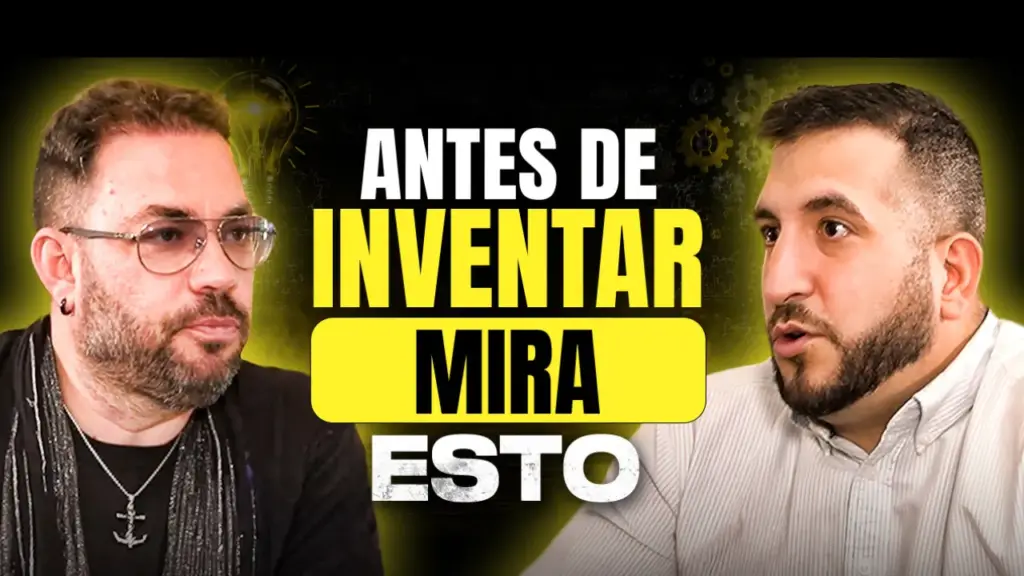
Through the conversation held in the Toque de Ingenio podcast with Luis Martín, founder of Academia de Inventores, Let’s analyze what it truly means. transforming an idea into a product, Why many inventions fail, and what role prototyping, technology, artificial intelligence, and education play in the creative process today.
The starting point: to reclaim the image of the inventor.
At a time when many people prefer to define themselves as entrepreneurial, innovative, or visionary, Luis Martín continues to advocate for a word that seems to have become somewhat sidelined: inventor. For him, this isn’t simply a commercial label, but a vocation that has accompanied him since his childhood. As he explains in the interview:
When I was nine years old, and people would ask me what I wanted to be when I grew up, my younger self would always say: “inventor.”
Beyond the anecdote, his perspective connects with a way of understanding innovation based on curiosity, experimentation, and the creation of real solutions.
It also advocates for an open conception of invention, strongly aligned with movements like Arduino, the 3D printing or the maker culture. In fact, he states it. he is not advocating for the patents, not through a dictated solution, but through a freely conceived, creative, and open invention.
For years, inventing seemed to be something reserved for large companies or specialized laboratories. Today, the tools are much more accessible to anyone.
This change is fundamental. The ability to create is no longer solely dependent on having advanced technical resources, but on being able to transform an idea into a tangible reality through a structured process.
An idea isn’t enough; inventing requires a process.
One of the most important messages of this episode is that inventing isn’t just about having ideas. A concept can be promising, but until it’s developed, tested, and validated, it remains simply a hypothesis.
Luis insists that the true inventive process encompasses all the necessary stages for a solution to be actually used in the real world. He summarizes this very clearly:
For me, the act of inventing is a unique combination of creativity and execution. It’s not just about creating and prototyping; for me, inventing encompasses all the stages involved in bringing it to a point where it’s being used in the market.
From this perspective, the difference between conceiving and inventing is significant. Prototyping It can mean creating a first functional version. “Inventing” implies going the whole way: conceptualization, technical development, manufacturing, validation, and implementation..
This vision is particularly interesting for any company that develops physical products. Creativity is important, but without execution, validation, and the ability to scale and industrialize them, ideas rarely make it to the market.
The transition from prototype to product.
One of the most interesting moments in the conversation arises when Luis explains the Development of Haze, A minimalist compass for cyclists, which managed to sell around 1,000 units through Kickstarter campaign.
This experience serves to illustrate a common reality in engineering: a functional prototype It doesn’t equate to a product ready for market. Many projects fail precisely during this transition. A prototype You can demonstrate that a solution is technically feasible, but there are still aspects to be resolved, such as repeatable manufacturing, costs, user experience, support, or logistics.
Luis honestly acknowledges the mistakes made during the project:
I believe that in every stage we went through with that project, we messed up.
Regarding Haze, problems emerged that had not been detected during initial development stages. One of the issues involved the use of magnetic sensors on bicycles, which were causing unexpected interference.
The learning was clear: many hypotheses seem reasonable until the product encounters actual usage conditions. Because of this, validating as early as possible is one of the key elements of any development process.
Prototyping also involves discovering what you didn’t know.
Despite the challenges, Luis highlights the significant learning gained during the project. One of the key values of prototyping That’s precisely it: discovering information that wasn’t available at the outset. A prototype isn’t just for validating a technical solution, but also for identifying risks, limitations, and areas for improvement.
In many cases, the errors reveal aspects of the product that would have gone unnoticed on paper. Even seemingly serious problems can ultimately become part of the solution. Luis summarizes this experience with a simple yet revealing phrase: We learned a lot..
This adaptability is one of the most important characteristics of any innovation process. Projects rarely follow the planned schedule, and the key difference often lies in how we respond to unexpected issues.
Artificial intelligence and the new era of invention.
Another central topic discussed in the episode is the The impact of artificial intelligence In the development of new products, Luis believes that we are currently experiencing a particularly favorable time for innovation. As he states during the conversation:
I often talk about the present time – it’s the best era for inventing, without a doubt.
Las Current tools allow design, program, document, and prototype At a speed that was unthinkable just a few years ago. The Artificial Intelligence It is reducing barriers to entry and making it easier for more people to turn their ideas into real projects. This is particularly evident in the area of software, where many tasks can be significantly sped up.
However, it also raises an interesting point: having better tools does not guarantee better solutions. Critical thinking, technical expertise, and validation remain essential. In the development of physical products, Furthermore, there are still challenges that no tool can eliminate entirely. manufacturing, assembly, testing, certifications, or industrialization.
La Artificial Intelligence It can speed up many things. stages of the process, … but it doesn’t replace the need to confront the reality of the product itself.
Academia de Inventores: teaching people to create technology, not just use it
The conversation also explains why Luis decided to found Academia de Inventores. His motivation came from personal experience: he had always wanted to invent, but could not find an environment in which to learn through regular, practical work.
The academy arises precisely to meet that need. It’s not conceived as a specific technological activity, but rather as a space where children and young people can to undertake personal projects using tools related to science, robotics, electronics, or digital manufacturing. Luis explains that motivation with a very representative phrase:
“I’ve always wanted to be an inventor, and it’s wonderful to be able to provide children with a space where they can do this regularly.”
The aim is not simply to teach technology, but to foster a way of thinking based on creativity, problem-solving, and experimentation.
Furthermore, the approach is clearly multidisciplinary. Rather than focusing on a specific tool, the aim is to enable students to to adapt to technologies They are constantly evolving.
Technological education as an investment in the future.
One of the most interesting debates in the episode centers around the importance of Technological education In contrast to more traditional extracurricular activities. Although disciplines such as programming, the robotics or artificial intelligence They are still often perceived as complementary, but their relevance continues to grow.
Beyond simply learning a specific tool, the real value lies in developing the ability to adapt to constantly evolving technological environments. Luis presents this from a very current perspective:
“Considering his interests in both English and programming, I would currently recommend programming to him, as it’s essential for keeping up with artificial intelligence and continuous learning.”
This idea is particularly relevant for both students and professionals. In a context where technologies are evolving rapidly, the ability to continuous learning It becomes a fundamental competitive advantage. The aim isn’t to create passive technology users, but rather people who can understand and utilize it to develop new solutions.
A clear conclusion: inventing is about creating.
After analyzing the case of Academia de Inventores, There’s a particularly clear idea: inventing isn’t simply imagining something new. To invent is to create. It’s to go from Idea for the prototype, of prototype to validation, of the validation for manufacturing and of the ready-to-use manufacturing
Luis Martín’s story demonstrates that innovation isn’t a straightforward or linear path. There are mistakes, technical problems, poorly calculated decisions, manufacturing difficulties, economic pressures, and hard-won lessons. However, there’s also a tremendous capacity for progress when there’s curiosity, a methodical approach, and a willingness to act. physical products, This difference is even more significant. A good idea can launch a project, but only design, engineering, prototyping, validation, and industrialization can transform it into a product ready for the market.
In i-mas We support businesses, startups, and entrepreneurs throughout product design and development process: From the initial concept through prototyping, engineering, electronics, automation, manufacturing, and industrialization.
Because an idea can be the origin of a great product. But only if it’s built correctly.
If you have a project in mind, Contact us and we help you take it from concept to reality.