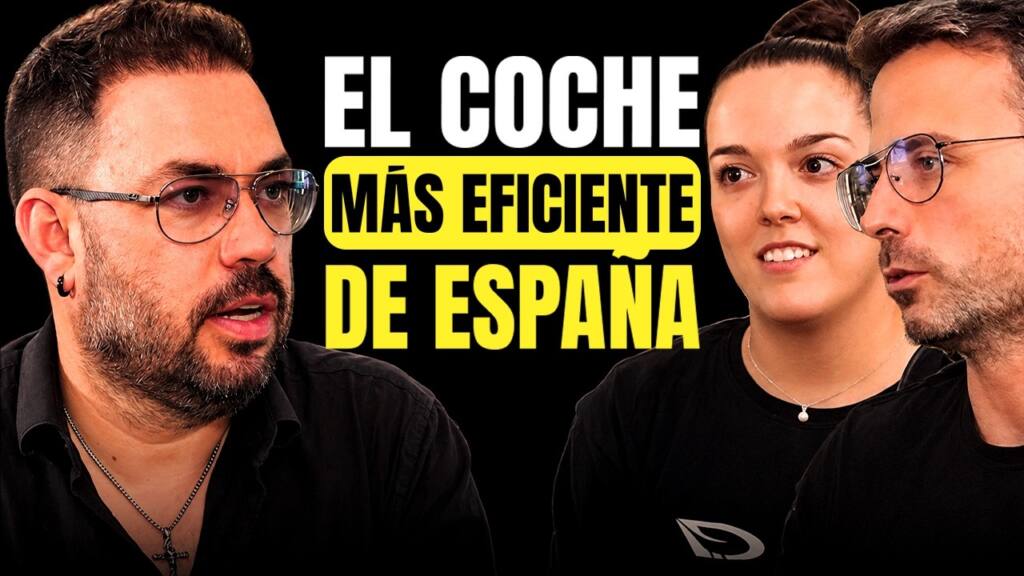
Micromobility in urban areas is no longer a trend: in Spain, around six million e-scooters are circulating, and more bicycles are being sold in Europe than cars. The problem arises when reaching your destination: where to safely store the vehicle and how to load it without loose cables or conflicts with neighbours. In chapter 69 of Toque de Ingenio, Branco Calleja explains why shared e-scooter schemes were withdrawn from many cities, what infrastructure is lacking, and how YUP Mobility transitioned from charging mobile phones to parking e-scooters and bicycles.
Guest: Branco Calleja, who was introduced in the episode as the founder of YUP Mobility. Interview published: December 2, 2025. Episode: 69. Duration: 1 h 5 min.
In this episode:
- Why have shared scooters disappeared from cities like Madrid, and what would make their return viable?
- What design decisions allow a loading bay parking area to function safely and effectively on a street?
- What growth-related mistake does the guest identify, and what changed as a result?
The conversation was recorded at i-mas’ facilities, the week following the Smart City fair, where YUP Mobility had presented its new hybrid parking system.
Urban micromobility: journeys of five to ten kilometers
White begins by dismantling a common misconception: micromobility isn’t just shared scooters. According to their definition, it refers to short journeys within a city, ranging from five to ten kilometers. Cities, they argue, are not yet equipped for this, and travelling these distances by car is not a sustainable option.
That category includes everything below a car: scooters, electric bicycles, cargo bikes, and even the small electric vehicles that are increasingly appearing in northern countries.
The figures illustrate the extent of the change. The scooter, which was largely viewed as a toy after the pandemic, is now being used daily by six million people in Spain. Across Europe, there are more than 250 million bicycles, and bicycle sales are now exceeding car sales.
Free floating: the technology came before the regulation.
Branco is clear on the rise and fall of the shared scooter: technology arrived before the regulations, and with money behind it, many companies entered cities seeking permission after already operating. Setting up the business was relatively easy; the challenge was in the operation itself.
The outcome was announced: vehicles abandoned everywhere, and residents complaining, which was entirely justified. Madrid was one of the last cities to ban these services. According to reports, the city has stated that, with a solution to address the chaos, they believe these vehicles are beneficial for urban mobility.
Branco reports that approximately four years ago, he suggested to the operators a neutral parking system, where any shared vehicle could park and charge, similar to the Bicing system. He was told that they didn’t need it. However, in projects with stations in northern European countries, their operating costs are now decreasing.
It’s forecast that the system will return based on stations. This is a practical argument: currently, battery swaps are carried out wherever each vehicle is parked, with vehicles left haphazardly parked overnight. And remember that Bicing was conceived with a station within ten minutes’ walking distance, which lost its appeal when users became accustomed to parking at the entrance.
Fragmented rules and cities designed for people, rather than for a community.
When Edgar asks what regulations currently apply to a scooter, the answer is that there are many different realities, because the rules vary depending on the municipality. Branco lives outside of Barcelona and when he arrives in the city, he’s unsure whether he needs to wear a helmet or have a registration. The user is the first one affected.
Regarding urban transformation, the text cites the statistic that eight out of ten people will be living in urban environments by 2050, in cities designed for cars. Paris is used as an example, which, under the guise of the Olympic Games, has been filled with cycle lanes. A French law prohibits parking cars five meters before and after a pedestrian crossing, and these spaces are being used for bicycle parking.
Amsterdam, remember, wasn’t always a city of bicycles. And in the city of 15-minute commutes, a light, electric vehicle can cover twice or triple the distance within that time.
Her stance on cars is firm: it spends most of its time parked, occupying space that could be used for parking, and an electric car isn’t inclusive. She views it as excessive luxury and believes that the ratio of one car per person will diminish in the city.
From charging phones to parking scooters: how YUP Mobility was born.
The company’s origins lie in mobile chargers. Branco explains that the idea was born at Shanghai Airport, when he observed a woman charging her phone at a charging station. They initially imported these chargers from China, but the after-sales service was a disaster, and they decided that the business only made sense if they developed the products themselves. This led to the chargers you now see in airports, shopping centers, and hospitals.
The pandemic led to the loss of all their clients. Shortly after, a colleague arrived at the office on a bicycle, and the question arose as to whether those same clients would have a similar need. They developed a first patented product designed for parking and charging electric scooters. At the time of the interview, there were over 7,000 units in Spain, France, and Belgium.
That success led to bicycles. Branco provides a statistic: four million bicycle thefts are reported in Europe each year, and those who experience one are more likely to return to using a car. The company split into Yup Charge and YUP Mobility, with the latter’s purpose being to create a public-private network of secure parking spaces. Four years after, they were selling in over 100 cities across four countries.
Design for the street: without cables, without an app, and vandal-proof.
“I don’t prefer to talk about “learning by doing,” but rather “learning by earning.””.
Branco Calleja 37:33.
The experience with mobile chargers led to the first decision: at an airport, they refused to install cables from the very beginning, because they broke before the maintenance was finished. There were three or four types of scooter cables, and the technology allowed them to be integrated, but they would break within two days. They decided to use secure parking areas where each user would charge using their own charger.
The second decision was simplicity. The initial product was disconnected, with a security code similar to a hotel safe, because no one downloads an app to park at a shopping center. Branco believes that this simplicity explains part of the success. For bicycles, two chains were incorporated directly into the parking area, so the user can simply remove the wheels and frame without needing a separate lock.
The hybrid product emerged from a logistics client who purchased both models and wasn’t sure which would be in higher demand the following year. A year later, they presented a patented and modular multi-modal parking system at Smart City, featuring intelligent panels, a free app for booking spaces, and an administration panel. This led them to municipalities: that same week, they were installing a competition won in seven municipalities in Mallorca.
Anti-vandalism, it’s been acknowledged, has meant sleepless nights: the product saw rapid success, and we had to continue producing it while searching for a solution. He adds that many public tenders don’t include maintenance, and that when something is already damaged, vandalism grows exponentially. The people developing product that person who lives on the streets must devise/create/form electronics and the mechanics for the absolute worst possible use.
Energy, business model, and the mistake of growing too soon.
YUP uses a walkable photovoltaic ground to power parking areas without construction work: solar tiles that replace traditional ones. A scooter parking area in a shopping center operates like this, without being connected to the grid. Branco acknowledges the challenges, including dirt and, above all, shadows, and summarizes it as being efficient but expensive.
They also install solar canopies, similar to those found in some Rioja wineries, and they work with recycled materials and locally sourced production (kilometer zero).
The business model involves selling the solution to companies and administrations, generating recurring revenue through maintenance and software. They don’t intend to monetize the user; rather, they want users to pay for excessive use, such as leaving a vehicle constantly running. International interest came from inquiries from companies in Switzerland, Germany, and Sweden.
“We had a scalable project, and we do now; we didn’t have a scalable product”.
Branco Calleja 63:21.
He says his biggest professional mistake was trying to grow too quickly, at a time when it wasn’t appropriate. They were selling to large corporations and entered into the logic of raising further investment rounds, but the product wasn’t yet robust enough. The money was spent very quickly, and they went through some very difficult months, which they overcame with a much clearer understanding of what to do.
What can another development team learn?
The conversation offers insights that extend beyond micro-mobility.
- Design for the worst user. A cable that worked in the lab broke on the second day when it was outside.
- Remove friction at the point of entry. A simple lockbox code was enough to begin; the app arrived after the service was already in place.
- Distinguish between projects and products that can be scaled. Having demand doesn’t mean having a product ready for growth; scaling beforehand costs money.
- Anticipate maintenance. A team without maintenance is vandalized and ceases to provide security.
At the time of the interview, YUP Mobility had just presented its hybrid parking solution and was preparing new, patented products focused on safe parking without loading.
At i-mas, we continue to be interested in how mobility is changing in cities and what products are needed to improve it. If you’d like to have more conversations like this, follow us. Toque de Ingenio; and if you are developing equipment that needs to operate outdoors, Tell us about your project..
To continue reading: An electric bicycle motor without a chain or gears..
Source of article: Interview with Edgar Guerrero on Toque de Ingenio with Branco Calleja. The quoted passages link to the minute of the conversation. The recommendations for other projects are a summarised editorial from i-mas.