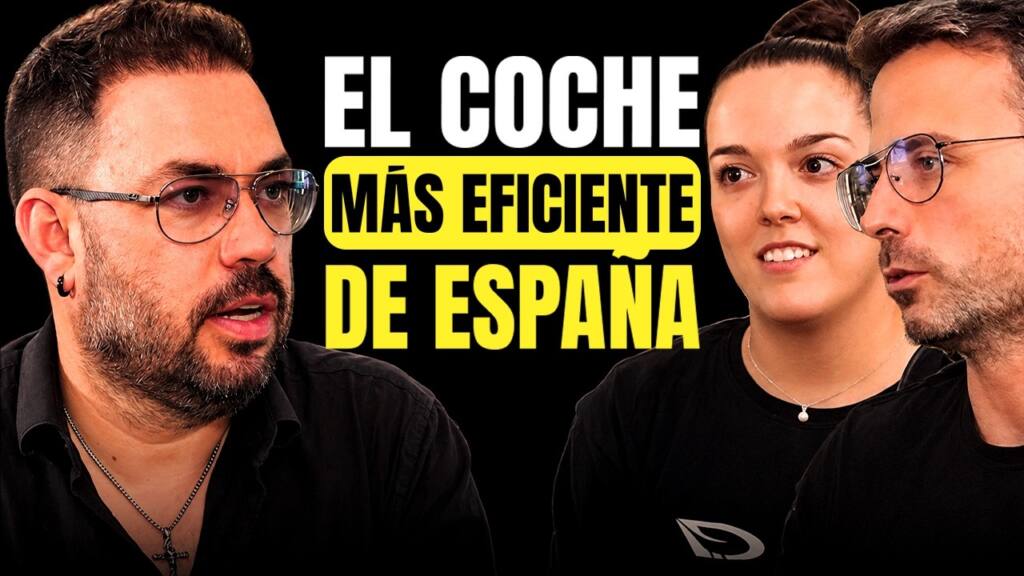
Designing an electric bicycle motor without gears requires a complete rethinking of the transmission system, not just adding assistance. Niche Mobility, a startup from Girona, has developed the ADTS – a central motor block that eliminates the chain, gears, and derailleur, and fixes the transmission ratio for the cyclist. In chapter 59 of “Toque de Ingenio,” Enric Delgado explains how the series hybrid system works, why they sell it to manufacturers rather than users, and what they learned from Volta Motorbikes before industrializing.
Guest: Enric Delgado, who was introduced in the episode as a co-founder of Niche Mobility. Interview published: July 15, 2025. Episode: 59. Duration: 1 h 10 min.
In this episode:
- How two electric machines, housed in a single unit, replace a traditional mechanical gearshift.
- Why is the motor sold to manufacturers with its own firmware, tailored for each bicycle?
- What industrialization decisions did the team make following their experience with Volta Motorbikes?
The conversation was recorded during the first week of July 2025, during a heatwave and one week after the Eurobike trade show. Enric brought the beta prototype of the motor to the table, and the team was estimating a period of one and a half years of work before they began production.
Replace the gear change with an electric transmission.
Enric is presenting an observation about the bicycle market: most electric bikes are hybrid models. The rider still needs to put in some effort with their legs, while the motor assists, and the gear changes remain manual and mechanical. Early automatic solutions from Shimano or SRAM automated the gear changes, but they continued to use gears and chains.
When the idea began to develop, around 2021, electric cars and motorcycles had already eliminated the need for gear changes. Furthermore, the transmission consolidates the cost of bicycle replacement parts – chain, gears, and sprockets. Niche’s objective was to remove this entire system, rather than improve it.
ADTS employs the hybrid series system that was used in Japanese cars over thirty years ago. In those vehicles, a combustion engine operated at a stable speed to power batteries which drove an electric motor. Here, the generator is driven by the cyclist.
“The combustion engine is our legs.”
Enric Delgado 09:45.
Within the unit, there are two electric motors. The first rotates with the pedals, converting the pedaling motion into energy and data. The second, which is not mechanically linked to the first, drives the rear wheel. The electronics continuously adjust the gear ratio, so there’s no need to change gears.
The regulations for electric bicycles limit the assistance to 250 W and 25 km/h. As Enric explains, the system adds the power generated by the cyclist to the power drawn from the battery, and sends the total to the wheel. Because the transmission is electric, it can even be reversed to allow for reverse gear in three-wheeled vehicles.
Control by rhythm, rather than by gear changes.
The parameter that governs the control is cadence. Each person has a comfortable pedaling rhythm, which, according to Enric, tends to be around 50 or 70 revolutions per minute. The user sets this value, and the system takes care of the rest.
A inclinometer within the motor detects whether the bicycle is going uphill, downhill, or on a flat surface. When starting a downhill slope, the system calculates the extra power needed to maintain speed and transmits this electronically. The cyclist maintains their cadence; the force they need to apply increases according to the chosen riding mode.
These modes function similarly to the maps found on a modern electric bicycle. Within each one, the app allows users to adjust cadence, level of assistance, and regeneration. There’s also an option for a manual control, although Enric notes that very few people request it.
Because the rear-wheel drive motor is disconnected from the pedals, it can regenerate energy during downhill sections and also brake the rear wheel. Enric proposed a combined braking system, with a disc brake at the front and the motor braking at the rear, all controlled by a single lever. The efficiency of the regeneration was yet to be tested; he noted that in electric motorcycles, it typically doesn’t exceed 15 or 20%.
Anti-theft is a consequence of the same principle. When the system is off, turning the pedals doesn’t move anything. The bicycle can be unlocked using a PIN on the screen or via Bluetooth when the mobile is nearby. This layer of Electronic engineering transform an architecture based on a pull system into multiple product functions.
Sell to manufacturers, not a kit for the end-user.
The basic package includes the engine and a touchscreen approximately two inches in size. The application adds configuration options, an expanded control panel, and error reports for the workshop. However, Niche doesn’t sell directly to cyclists; its customer is bicycle manufacturers.
Enric describes the business model as B2B with a leaning towards B2C. The company provides educational support to the end-user, encouraging them to purchase the engine through their store, but their dealings with the manufacturer are different: fewer parts, simpler assembly, and a belt instead of a chain.
At the time of the interview, Bosch held half of the European market for engines. According to Enric, many smaller manufacturers are unable to access that brand due to the payment terms and minimum order quantities, and Niche sees this as an opportunity. Their expectation isn’t to replace an existing engine, but rather for a brand to develop a new platform around ADTS.
The team has decided against selling a kit that would allow users to install it themselves. Each model – whether urban with small wheels, trekking, or cargo – receives its own, specifically tailored firmware, adapted to the wheel size, weight, and intended user, which has been tested by Niche and the manufacturer. Regarding the battery, they initially intended to supply it, but since the manufacturers already had their own suppliers, they opted to adapt to each battery and its BMS, whether or not it includes CAN communication.
Three prototype iterations and a series of zeroes.
Enric summarized the process in three stages: a proof of concept, an alpha prototype which validated it, and the beta prototype he presented in the interview. Fifteen units of the beta prototype had been produced, a series of “zero” units intended for testing by users and technical experts from interested manufacturers.
A significant portion of the pieces found inside the Beta were custom-made as prototypes. This pace of prototyping It enabled the engine to be adapted for three types of vehicle before Eurobike, where, according to Enric, the concept was well-received.
The biggest technical challenge, in his words, remains fitting everything inside. The team’s aim was to avoid being larger than a conventional engine, but within that volume, it’s possible to accommodate two electric machines, gears, and electronics. Each new cable or sensor requires reworking steps and wall thicknesses, and the work feels more like precision watchmaking than engine mechanics.
That effort of product design and development It has a commercial return. Following the modifications made, the bicycle weighs between one and 1.2 kilos less than with the original components, and the price target is to match or slightly undercut a standard motor plus its transmission.
Learning about Volta Motorbikes before industrializing.
Niche is sharing a co-founder with Volta Motorbikes, which designed and manufactured an electric naked bike for a 125cc license. Enric explains that this project involved establishing their own production line from scratch, and that the experience proved to be challenging and financially demanding due to the volume of production required.
The first lesson was to identify the team’s strengths. Enric is an industrial designer, and the founder is an engineer; their value lies in engineering and product development, not in manufacturing.
“If you’re dealing with a problem without understanding it, you’ll continue to have difficulties.”
Enric Delgado 52:05.
Because of this, Niche decided to outsource production, but not simply as a one-off commission. They were looking for an industrial partner, and they found one in the Mondragón Corporation through Copreci, which entered the second round alongside Clave Capital and other organizations. The manufacturing will take place in the Basque Country, utilizing suppliers from their ecosystem and some external specialists.
The second lesson was to invest in talent, even when attracting people to a location a hundred kilometres from Barcelona is difficult. The team settled in the University of Girona’s science and technology park, within a growing cycling ecosystem.
What remains until production.
When the episode was recorded, Niche expected a year and a half of type approvals, testing and certification before starting production in late 2026 or early 2027. In the introduction, Edgar sets out a target of 100,000 units a year from 2027. The alpha phase was funded through the founders’ own capital, crowdfunding and business angels, while the second funding round was intended to take the company through to industrialisation.
During that period, the plan was to collaborate with interested brands: to receive a bicycle, install the engine, return it, and gather feedback, with the aim of presenting specific models at the next Eurobike in collaboration with ADTS.
Niche will maintain the product, the development, the commercial aspect, and after-sales service. Enric points out that users go to the engine manufacturer when something goes wrong, so they are preparing a diagnostic platform via USB and a motor replacement procedure.
What can another development team learn?
The Niche Mobility case offers four key lessons for anyone developing an electromechanical product:
- Remove before automating. Automating a mechanism preserves its spare parts; a different architecture can cause those parts to disappear.
- Design with the available space in mind. From the outset, establishing the maximum size of the set will streamline decisions regarding mechanical, electronic, and wiring aspects.
- Adapting to the customer’s supply chain. Giving up selling the battery opened more doors than a closed-off set would have.
- Separating development and manufacturing with a partner involved. Producing without industrial knowledge consumes capital and attention that the product itself requires.
At the time of the interview, Niche Mobility was in beta prototype phase, with fifteen units undergoing testing, and industrialization scheduled for the end of 2026. The list of materials was being reviewed with the industrial partner.
At i-mas, we develop products that integrate mechanics, electronics, firmware, and prototyping within compact volumes, and we support the transition from prototyping to mass production. If your project requires more functionality in a smaller space, or if you need to prepare for industrialization, Tell us about your project..
To continue reading: How do you build an electric outboard motor from Menorca?.
Source of article: Interview with Edgar Guerrero on “Toque de Ingenio” with Enric Delgado. The excerpts cited link to the minute of the conversation. The project recommendations are an editorial summary from i-mas.