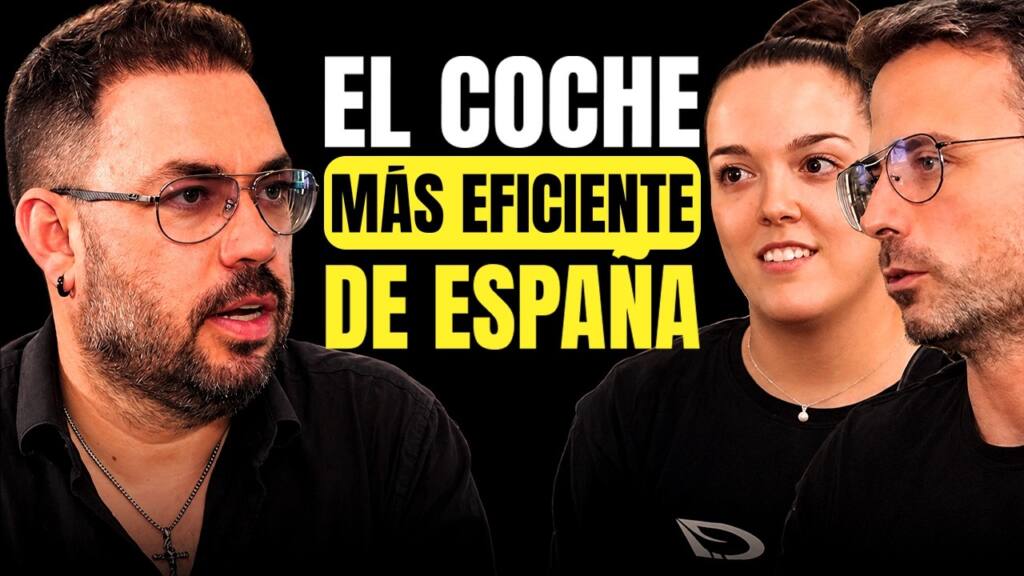
A tractor costs from 60,000 euros, burns diesel and needs a person sitting on it for eight or ten hours. The AG-X costs around 100,000, is electric, has no cab, no steering wheel and works with nobody inside. It is not a tractor with autopilot: it is a different machine, designed from scratch so that there is nobody to sit down.
Behind it is Pau Palau, an electronics engineer and the CEO and co-founder of Agrin’Pulse, a start-up from Lleida that designs and manufactures electric, autonomous tractors. He started in May 2024 with his partner Jordi; two years and three iterations later they are producing the first batch and building a factory for more than a thousand robots a year.
In this episode of Toque de Ingenio he explains how an agricultural robot gets developed in a sector where the alternative is not a technological competitor, but nobody being willing to do the work.
Guest: Pau Palau, CEO and co-founder of Agrin’Pulse. Conversation published: 12 November 2026. Length: 1 h 10 min.
In this episode:
- Why farming is mechanised but not robotised, and where exactly the leap lies.
- Which architectural decisions make it possible to sell an electric robot at the price of a diesel tractor.
- Why the hard part is not making the tractor drive itself, but making it operate the implement.
The problem: it is not technology that is missing, it is people
The sector’s figures explain the project better than any sales pitch. In Spain only one in twelve owners of farm holdings is under 40. Every summer the fruit harvest in Lleida needs more than 20,000 seasonal workers, almost all of them from abroad. And the tractor is still one of the most dangerous machines there is: around 60 people die every year in Spain from rollovers, with some 300,000 tractors running without a roll bar.
Pau knows the problem from the inside, because his family are farmers and his older brother is the one who stayed on the family holding. Asked why people his own age do not stay in farming, his answer does not point at technology:
«Very often it is your own parents who tell you: do something else, this is too hard a life.»
Pau Palau, 17:14.
On top of that comes a financial structure that surprises anyone coming from industry: the farmer funds the whole season up front — it can be 300,000 or 400,000 euros of working capital — and gets paid once a year, around 20 December.
«You do not know the price you are selling your fruit at until you get paid, literally.»
Pau Palau, 17:22.
Mechanised yes, robotised no
The first clarification in the episode dismantles a cliché. Farming does not work as it did in the nineteenth century: it is heavily mechanised, but in one specific layer. Data is captured, sensors are used and action is taken on them; almond, grape and olive harvesting has been mechanised with harvesters and shaker umbrellas.
What does not exist is the next step: taking that data, training models and making the task autonomous. According to Pau, the Dutch have gone furthest, above all in greenhouses, while in Spain the level of mechanisation is high but robotisation has not arrived yet.
And there is an economic filter that rules out many eye-catching solutions. The harvesting robots doing the rounds on video are still, in his experience, at an experimental stage, and the reason is throughput:
«If a person can pick you 100 kilos an hour, or 200, and the robot picks 10, however much mechanisation and automation it is doing, your fruit will go off first.»
Pau Palau, 10:38.
That is why Agrin’Pulse dropped its original idea — a fruit-picking robot — as unviable in money and in timescales, and went for the tractor instead.
What the AG-X is: take out the cab and start from scratch
The design concept is literal. If a tractor is a bonnet, a cab and a hitch, the AG-X removes the cab and sticks the bonnet onto the hitch. The result is a platform a metre and a half wide, about three metres long and a metre and a half high, running on tracks, whose insides are essentially batteries and computing power.
The first version, the AG1, was built in three months on top of an existing commercial platform. It did not work: it was light, underpowered and carried all the integration problems of somebody else’s product. That failure is what defines the company:
«That was one of the turning points, saying: I do not want to depend on anyone, we are going to do all of it ourselves.»
Pau Palau, 1:08:10.
The decision that makes the robot affordable: 48 volts instead of 400
Here is the electronic architecture decision that explains the price. The large manufacturers and much of the competition work at 400 V because they reuse automotive batteries. Agrin’Pulse did the opposite: low voltage, 48 V, and its own battery developed in house.
The reason is not technical, it is maintenance. A village workshop or a regional dealer has neither the training nor the tools to work on high voltage. At 48 V, repairing, distributing and transporting the battery stop being a problem.
In exchange they had to solve the current: they work at over 1,000 nominal amps without the battery heating up. The trade-off is favourable, because the robot does not need top speed — it runs at about 12 km/h — and it does need force: Pau talks about up to twice the torque of an equivalent combustion tractor.
The pack is more than 96 kWh of LFP battery, in two 400-kilo modules that can be swapped with a forklift. Range is 6 to 10 hours working with an implement and up to 20 on light tasks, with three charging options: AC, a battery bank that charges it in three hours, or physically swapping batteries for plots with no mains supply.
With the whole value chain in house — batteries, power electronics, mechanics, wiring; only the paintwork is outsourced — the AG-X comes out at the same price as a combustion tractor, around 100,000 euros, whereas a commercial electric tractor can run to 200,000.
The hard part is not driving: it is operating the implement
Guiding a tractor in a straight line has been solved for years with GPS. The challenge appears when you remove the operator and have to replace everything they did without thinking.
The robot is given the perimeter of the plot, a starting point and the row width, and with 3D lidar, depth cameras, radar, an IMU and RTK GPS it maps the field in real time. Redundancy is not a luxury: the same machine works in thick fog at minus five degrees in winter and at 42 degrees in summer.
But the part Pau underlines is a different one. A tractor does not work on its own: it works with an implement hitched behind it. And teaching a machine to operate a flail mower or a sprayer means modelling turning radii, lateral inertia when the implement shifts sideways, even how the liquid moves inside the tank when braking on a slope.
«For us it is safety first and efficiency second.»
Pau Palau, 40:28.
The technical challenge that took them longest to close was the kinematic model, because of the tracks: a traction system that, by definition, is slipping the whole time. The AG-X prototype has clocked over 3,000 hours of real work, and those hours are development and data capture at the same time.
The bar they set themselves is deliberately modest, and it is a good yardstick for any industrial robotisation project:
«The robot is not trying to be more efficient than the person, but to work at least as well as the person.»
Pau Palau, 56:09.
From prototype to batch: where the product stands today
Agrin’Pulse is building the first batch of ten units, finishing certification and selling at the same time. The recent mechanical iterations are not about performance but about industrialisation: making assembly easier and being able to outsource metalwork, harnesses and wiring so as to become a research and assembly company.
They chose to start with two implements — a flail mower and a sprayer — because they cover around 70 % of the work and serve almost every high-value row crop: grapes, apples, citrus, pistachio. Other implements will be added on demand, on the condition that the system stays brand-agnostic.
With the first customers the model is hands-on: they map the plots, run the onboarding, and the first 25 get technical service, warranty and subscription for life. The efficiency argument they are demonstrating in the field is that a single operator can run two or three robots at once.
The ambition is not local. They are building a factory with capacity for more than a thousand robots a year and are already securing land for the next one:
«We want to become a global player in the manufacture of agricultural robots.»
Pau Palau, 1:01:59.
What another development team can take from this
Beyond the agricultural case, the AG-X is a useful example of hardware development under hard constraints:
- Size the product against the real alternative, not the ideal one. The robot does not compete with a perfect tractor: it competes with there being nobody to drive it. That changes which features are non-negotiable.
- Architecture decides price and maintenance. Choosing 48 V instead of 400 does not improve performance: it makes the village workshop able to repair it, and the product sellable.
- Integrating is not always faster. The AG1’s commercial platform saved three months and cost a full redesign. Starting from scratch was slower and turned out cheaper.
- The product is not the machine, it is the task. Driving itself was all but solved; what was missing was operating the implement. The value sat in the layer nobody was looking at.
- Validate with the user before scaling. Farmers did not like the AG1, and that redefined the product. Those 3,000 prototype hours are customer hours, not laboratory hours.
From prototype to production, at i-mas
Going from a bought-in platform that does not fit to your own robot, certified and manufacturable in batches, is exactly the journey we make every day. At i-mas we approach product design and development end to end, from prototyping and electronic engineering through to industrial automation and assembly, with mechanics, electronics, software and industrial design under a single engineering roof.
If your project needs to go from prototype to production, tell us about your project.
Further reading: the Spanish car that runs 1,829 km on one litre, the Dátil from UMH Team.
Source: interview by Edgar Guerrero with Pau Palau on Toque de Ingenio. The figures on price, range, production and market are those given by the guest during the conversation. The quoted passages link to the exact minute. The recommendations for other projects are an editorial synthesis by i-mas.