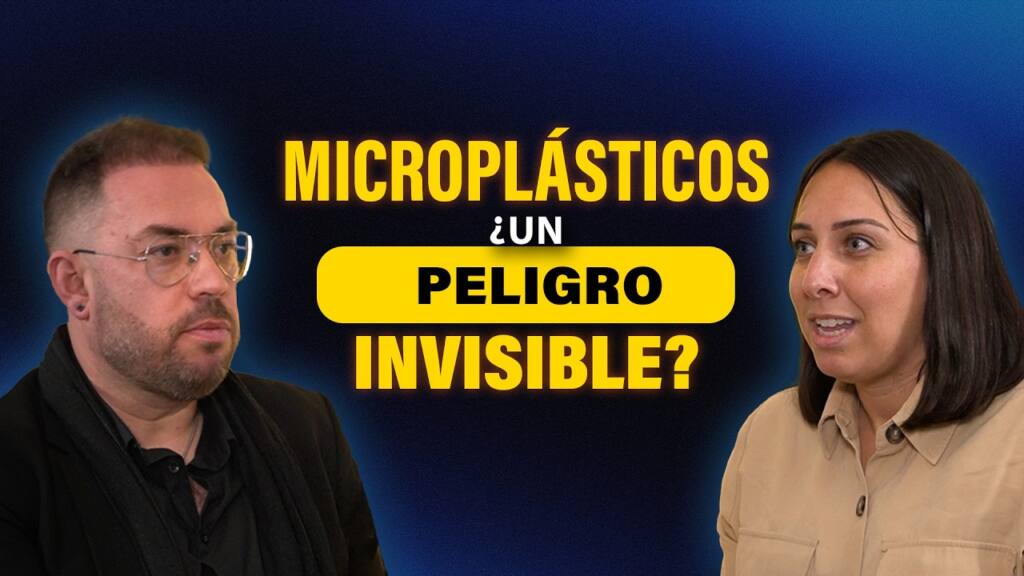
Removing microplastics from water requires capturing them, separating them, and measuring the results of the process. Amparo Fernández explains how Captoplastic addresses these tasks in chapter 41 of “Toque de Ingenio.” The discussion connects a university-developed technology with the creation of physical equipment, and highlights collaboration with i-mas to transform process requirements into devices that can be used.
Guest: Amparo Fernández, who appeared in the episode as Business Development Manager at Captoplastic.
Interview published: March 11, 2025. Episode: 41. Duration: 57 min.
In this episode:
- How a magnetic property-based device allows for the separation of microplastics from a water current.
- Why measuring removal was a necessary development for evaluating the technology.
- What does the collaboration between a scientific team and a product engineering company offer?
Amparo has positioned the project within water treatment and the need to manage plastic particles which can arrive through various routes. The article focuses on the industrial solution described during the interview. The tests, installations, and plans cited are for March 2025.
Understanding where to intervene in the water treatment process.
The interview begins by explaining various origins of microplastics. Amparo mentions particles created for a specific purpose, and others that arise from the degradation or detachment of materials. For example, fibers released when washing synthetic clothing are cited as a common source.
Following this, the conversation moves on to describe the stages of a wastewater treatment plant. It’s important to understand that removing a contaminant from the water doesn’t necessarily solve the problem of what happens to it afterwards. If it ends up in another part of the treatment process, its management remains part of the overall issue.
Captoplastic proposes to intervene at an early stage of the described process, with the aim of preventing microplastics from continuing to advance to later stages and into the sludge. The position of a team within a facility determines their function and the characteristics of the water they receive.
For an engineering project, that location must be defined with precision. It’s important to know the flow rate, the components present in the current, and its relationship with existing equipment. The technology needs to integrate into a process that already performs other functions and which must continue to operate effectively.
How does the magnetic capture described by Captoplastic work?
Amparo explains that the technology uses a collector with a mineral-based nature, possessing magnetic properties. When introduced into the water, it forms aggregates with microplastics. A magnetic field then allows these aggregates to be separated from the current.
The interview does not reveal the confidential formulation of the captor. Instead, it describes the functional sequence: incorporating the material, facilitating the capture, and removing the added element. This explanation allows us to understand the structure of the process without attributing a composition that has not been disclosed in the conversation.
The selectivity is important because wastewater contains other components. The solution needs to work in a complex medium, with both organic and inorganic matter, in addition to the particles that need to be removed. Performance in a simple sample is not sufficient to describe any actual usage conditions.
The focus of development teaching involves defining the application environment with the same level of care as the fundamental operating principle. For a solution Industrial engineering, The entry and exit requirements allow for a scientific idea to be transformed into a process that can be designed, tested, and implemented.
Recovering the lead and organizing continuous operation.
Once the aggregate has been separated, the process aims to divide the collector and the microplastic. The captured material is stored, while the collector is refurbished for reuse. This recycling is an integral part of the plant’s operational plan.
This decision has consequences for the team. It’s necessary to coordinate dosage, separation, recovery, and storage, as well as the water flow. Automation should sequence these operations so that the entire system can operate continuously.
Amparo also acknowledges that there may be losses and a need for review. This level of precision is important when interpreting reuse objectives. Designing a recirculating circuit does not equate to demonstrating an absolute absence of consumption or maintenance throughout the lifespan of an installation.
This episode demonstrates how sustainability and operational efficiency are linked in specific decisions. Recovering a material can reduce the need for replacement, but it requires equipment capable of separating and processing it. The benefits should be evaluated alongside the resources and tasks involved in the entire process.
Measuring the elimination was a crucial part of the development process.
Captoplastic not only needed to demonstrate its ability to capture particles, but also had to understand how much it eliminated and how to assess the results. Amparo explains that the company invested significant effort in developing an appropriate quantification method for complex waters.
The question that summarizes that need is:
“How much are we removing from the middle”.
Amparo Fernández 34:37.
The interview describes a method that involves capturing and processing a sample before obtaining a result based on mass differences. The key aspect of this example is the relationship between technology and measurement. Without a way to evaluate the effect, it’s difficult to compare versions or justify performance.
Amparo distinguishes between laboratory results and results from developing plants. Maintaining this distinction prevents automatically transferring a figure obtained under specific conditions to any installation. To properly evaluate a solution, it’s important to understand the type of water used, the method applied, and the validation stage.
A development team can apply the same logic to other processes: defining how improvement will be measured before concluding that it has been achieved. The evaluation system is part of the project and may require its own work, tools, and criteria for comparison.
Collaboration with i-mas to develop the physical equipment.
Edgar and Amparo explicitly explain i-mas’s involvement. Captoplastic contributed its technology and process requirements; the collaboration focused on developing and improving physical devices. This episode thus distinguishes the scientific knowledge from the mechanical and industrial solution that enables its application.
Amparo explains that they were starting with initial prototypes and that they needed to develop and refine them further. She highlights the possibility of sharing challenges and working together to find solutions.
“We felt comfortable sharing all the problems we were facing with you”.
Amparo Fernández 42:58.
That exchange allows you to transform an idea for the next stage into concrete requirements. Fluid routes, functions, and applicability must be coordinated with the final form of the team. Collaboration becomes more valuable when both parties understand what the other needs to achieve.
The case illustrates the role of the prototypes and product validation In the transfer of technology, a scientific principle can be defined, while the way it is actually applied still requires further development. Physical testing helps to bridge that gap by providing information that allows for improvements to the device.
Scaling a technology requires preparing for its adoption.
The interview highlights the origins of Captoplastic within a university patent and the influence of investors who helped establish the company. Subsequent development required resources for research, quantification, and equipment development. The journey involved distinct stages with different objectives and timelines.
Amparo also explains the difficulties of implementing a solution when buyers are still defining their needs. Regulatory and market decisions influence adoption, but this episode doesn’t replace a review of existing requirements for a specific installation.
For the company, “scaling” means handling increased volume and offering a solution that the client can implement. This requires examining the team, measuring the results, and managing the materials being removed. The sales proposal needs to clearly explain the entire process and the conditions under which it delivers value.
What can another development team learn?
- To define where technology is integrated and what conditions will be found in the actual process.
- Developing a measurement of performance, alongside the solution that is being validated.
- Coordinate scientific knowledge, team design, and operational needs.
- Distinguishing laboratory results, plant testing data, and scaling objectives.
Working with Captoplastic demonstrates how i-mas can help transform a proven technology into physical devices and subsequent product versions. If your company needs to move from a tested concept to a device that can be used, you Please tell us about the project and its requirements..
To continue reading: How Bubbl3s approaches the development of a sustainable technological product..
Source of article: Interview with Edgar Guerrero and Amparo Fernández on Toque de Ingenio, published on March 11, 2025. The quotes link to the relevant sections of the video; the key takeaways are a summarized editorial version of the conversation.