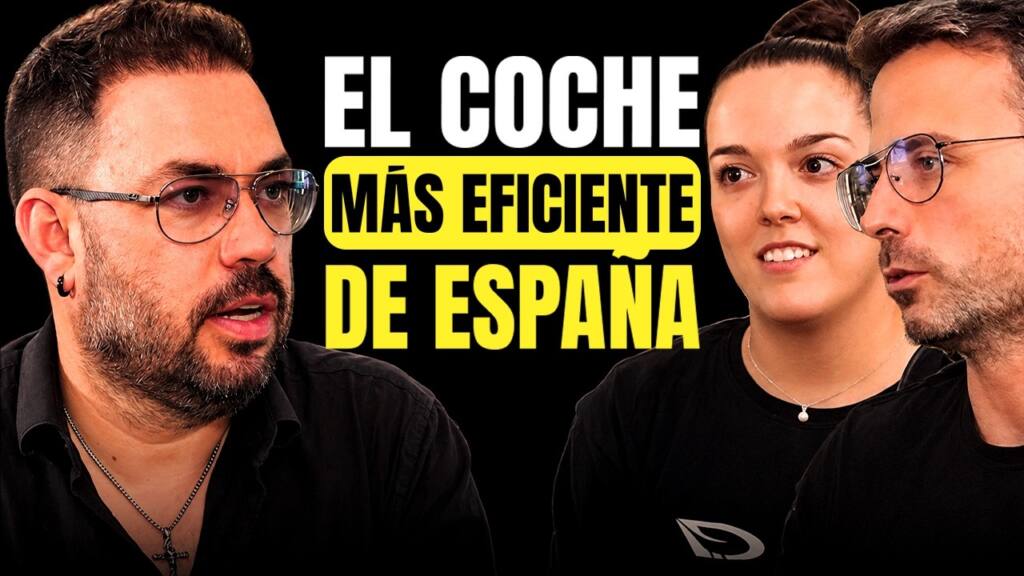
The manufacture of autogiros involves product design, mechanical development, testing, and a maintenance network to support each aircraft. Cristina Alonso, CEO of ELA Aviación at the time of the interview, explains how these decisions are linked in a company that manufactures in Fuente Obejuna, Córdoba. Chapter 30 of “Toque de Ingenio” allows us to understand the process from an idea for improvement to a product that functions outside of the factory.
Guest: Cristina Alonso will be the CEO of ELA Aviación in December 2024.
Interview published: December 2, 2024. Episode: 30. Duration: 43 min.
In this episode:
- What differentiates an autogiro from a helicopter, and how does this difference influence the product’s development?
- Why the rotor innovation requires years of work, testing, and accumulated experience.
- How are manufacturing, distribution, training, and technical service integrated within an international market?
Edgar Guerrero visited the ELA facilities and spoke with Cristina, alongside the aircraft. The interview combined industrial history, business decisions, and a product explanation. References to the Revo model and the commercial situation illustrate what the company was presenting in December 2024, allowing for an examination of a development process, without simply converting past expectations into subsequent results.
What is an autogyro, and what design problem does it present?
An autogyro is a type of aircraft with a rotating rotor, which spins due to airflow during flight. The engine provides the thrust that allows it to move. Cristina uses this distinction to explain why its operation and its capabilities differ from those of a helicopter, although both share a visual appearance that can be confusing to those who see them for the first time.
Her explanation begins with a brief idea:
“We are flying in autorotation”.
Cristina Alonso 5:14.
For product development, the key is to translate that principle into requirements: how the aircraft takes off, the space it needs to operate in, and what the user expects from it. Comparing commercial aircraft requires maintaining these conditions. A single advantage for one application does not make two aircraft interchangeable for any mission.
The conversation also recalls the Spanish origins of the autogyro and the work of Juan de la Cierva. ELA is presented as a company that has continued to develop this concept for a contemporary market. This continuity demonstrates that innovation can involve refining a well-established design and finding a combination of performance, usability, and commercial viability that makes sense.
Manufacturing of autogiros: from the technical principles to the complete product.
Cristina describes a history spanning over two decades of manufacturing and model development. Her account covers aspects such as cabin design, team specialization, and the establishment of an industrial activity in Fuente Obejuna. The location is significant because the product relies on people, facilities, and knowledge that are built up over time.
Edgar links that experience with the difficulty of selling technology developed in Spain. Both recall instances where the product’s origin led to doubts before the recipient learned about its capabilities. The practical learning is clear: the manufacturer needs to explain and demonstrate what the technology does, as well as have a technical solution available.
Manufacturing doesn’t end when a single unit leaves the assembly line. The product must be able to be maintained, receive replacements, and retain a clear relationship with its documentation and configuration. In an international market, these decisions condition both the growth and the ability to produce more units.
For a company that works in product design and development, This vision requires a complete cycle to be considered. The value proposition, the mechanical requirements, and the intended use must be aligned from the outset. The interview proves useful precisely because it connects conversations that are often separated between departments.
The Revo rotor and the limits of a commercial promise.
A portion of the episode is devoted to the Revo and a take-off system presented by Cristina as the result of several years of work by Emilio José López. This improvement aims to reduce a limitation that arises when comparing the autogiro with other aircraft: the space required to begin flight.
The significance of this case lies in defining the problem. The team doesn’t simply add a function; they work on a condition that impacts the applications and the user’s perception of the product. A change of this kind affects the architecture and requires integrating the solution with the overall system’s functionality.
The distances and advantages mentioned in the conversation are part of the manufacturer’s presentation on that date. The interview does not provide an independent comparison of all operating conditions. Therefore, its value for another engineering team lies in understanding the development objective and the effort required to achieve it.
When undertaking any industrial project, it’s important to formulate an improvement in a verifiable way: specifying the limitation you want to reduce, under what conditions, and with what evidence. This formulation prevents a vague, ambitious commercial statement from replacing the criteria used to evaluate the outcome.
Prototyping and validation of a mechanical development.
When Edgar asks about the prototypes, Cristina describes a lengthy and delicate process. She doesn’t provide a precise number of units. She highlights the developer’s experience, the calculations, and the testing involved in an innovation that will eventually be used in flight.
This episode demonstrates that a prototype is not just a small or preliminary version of the final product. It can be used to study a mechanism, test an integration, or address a specific uncertainty. The number of iterations alone reveals less than the questions it enables to be answered.
That approach resonates with functional prototypes and the manufacture of parts. Before ordering a sample, it’s important to define what needs to be observed and how the results will influence the subsequent decision. It’s also necessary to distinguish between testing a single component and validating the entire system.
The conversation does not present i-mas as the developer of ELA’s aircraft. The editorial connection lies in a shared discipline: transforming requirements into physical solutions and obtaining evidence before scaling up production or compromising performance.
Distributors, training, and maintenance as part of the product offering.
Cristina insists that selling an aircraft in a country requires planning what will happen afterward. She discusses distributors, instructors, technical training, and the availability of spare parts. The distance between the factory and the client highlights an issue that also applies to industrial machinery and equipment.
Let’s get straight to the point:
“If you don’t have technical support, you won’t be able to sell.”
Cristina Alonso 33:08.
Maintenance is a part of the purchasing decision. The customer needs to know who to contact and how to restore product availability when an issue arises. A weak support network can limit the adoption of an interesting technical solution.
The episode mentions professional applications such as surveillance and certain agricultural uses. Each of these introduces different requirements for operation, service, and marketing. For another manufacturer, the lesson is to segment the market by real-world problems and to investigate what organization is needed to address them.
Questions regarding the development and manufacture of autogiros.
What distinguishes an autogyro from a helicopter?
The difference explained in the interview concerns how the main rotor rotates during flight. In an autogyro, it operates through autorotation, while the engine provides thrust for movement. This architecture dictates the performance and operational requirements of the entire system.
Why prototyping should begin with a technical question.
Because a sample only provides a useful answer if you know what to check. The rotor’s development illustrates the need to study mechanisms and integration through iterative processes. The outcome of a test should help determine the next step in the project.
What can an industrial company move from this situation?
The link between mechanical development, manufacturing, and after-sales service. Before scaling up, it’s important to verify that the product addresses a genuine need, that it can be produced consistently, and that the customer will have ongoing support when they use it.
Four key lessons for successfully launching a technical product.
- Convert these technical differences into specific requirements and applications.
- Define which uncertainty each prototype or experiment is designed to address.
- Designing the manufacturing process, along with maintenance and the supply of spare parts.
- Prepare the commercial and technical network before expanding into new markets.
In i-mas, product development and the industrial assembly They link design decisions with the preparation of manufacturable units. If you are defining a new team or mechanism, you can Tell us what you need to develop. And what stage is the project at?
To continue reading: Aerospace engineering and hardware development with DCubed..
Source of article: Interview with Cristina Alonso on Toque de Ingenio, published on December 2, 2024. The quotes link to their passages in the video; the applications to other projects represent an editorial summary from i-mas.