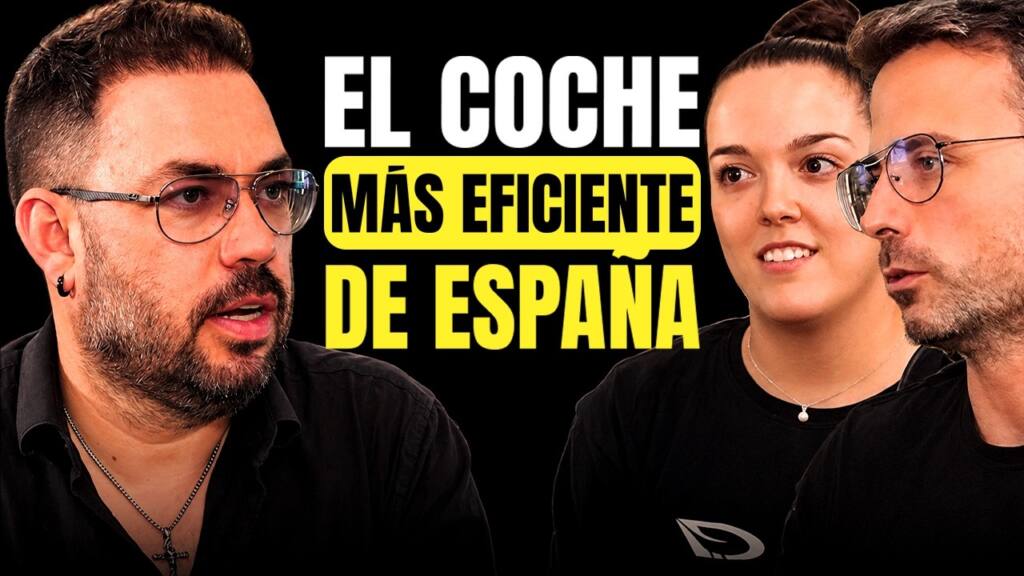
Aerospace engineering requires transforming theoretical knowledge into systems designed for very specific conditions. Guillem Quintana Buil explains this learning process through his experience at DCUBED in Munich, in chapter 42 of Toque de Ingenio. The conversation combines the development of mechanisms for satellites, technical integration, and a professional career within a German startup, with a personal reflection on how work changes after leaving university.
Guest: Guillem Quintana Buil, an aerospace engineer at DCUBED during the interview.
Interview published: March 18, 2025. Episode: 42. Duration: 1 h 20 min.
In this episode:
- What is the difference in distance between solving a problem and designing a physical system that needs to function?
- How mechanisms and structures are integrated into satellite development.
- What does Guillem talk about regarding his experience working at a startup, and learning to adapt to a different industrial environment?
Guillem recalls that his interest in space began when he witnessed a flight of the Space Shuttle. This curiosity led him to study aeronautics and, subsequently, to participate in experimental projects. The interview documents his career path and his views, as they were expressed in March 2025; comparisons between countries are presented as personal experiences, rather than as a uniform description of all his endeavors.
Learning engineering also means learning to select components.
The race provided Guillem with a foundation in mathematics and physics, which he appreciated when he started working. In the interview, he distinguishes between solving equations and facing a design that requires a specific valve, conduit, or component.
That step requires a combination of calculation and judgment. The component must fulfill a function, but also fit within specific dimensions, availability, and integration conditions. The problem ceases to be fully defined as in a typical exercise, and instead requires formulating questions before seeking the answer.
Guillem particularly remembers the experiences where he was able to work with sensors and observe physical behavior. Regarding what attracted him to the profession, he stated:
“to have something tangible”.
Guillem Quintana Buil 5:55.
The concept explains a desire to build and test, as well as to simulate or document. For a development team, maintaining contact with actual behavior helps to connect design decisions with their consequences.
Integration connects the work of different specialties.
During the conversation, Guillem describes the role of those who technically coordinate a system. A mechanical design has limits on mass and volume; a printed circuit board occupies space; and wiring requires a route. Each local decision can affect other disciplines.
Integration involves making those parts compatible while maintaining the overall requirements. It doesn’t require one person to replace all the specialists, but rather a shared understanding of interfaces, limitations, and changes. A component that functions correctly on its own can actually cause problems when integrated with the rest.
This reasoning has applications beyond the physical space. Whether in a machine or a device, the components need to know what conditions they must adhere to, and when a modification affects the rest. Making these dependencies visible allows for the detection of conflicts before they occur during assembly.
La Industrial development engineering It’s crucial to establish that level of coordination. Defining the requirements and reviewing them with the involved disciplines will help the project progress as a cohesive system. The quality of the outcome depends on the individual components and how they are linked together.
What mechanisms does DCUBED develop for the satellites?
Guillem explains that a part of DCUBED’s activity involves mechanisms for deploying elements. A satellite may need to travel with folded components during launch, and then deploy them afterward. The mechanism must securely hold them during a demanding phase, and allow them to open when necessary.
The interview links that work with loads and vibrations during launch. However, the function isn’t limited to the final movement; it also encompasses everything the assembly needs to withstand before reaching that point. The design must consider the entire sequence of use.
Guillem also mentions solar panel projects and the development of structures that would be printed in space as the panel deploys. He describes a complex project his colleagues were working on, with technical challenges still being addressed.
This example demonstrates how a transportation restriction can create a design opportunity. If a component needs to travel in a compact form and then be configured for further manufacturing, storage, and deployment, all of these phases become interconnected. The solution must address all of these stages.
The tests reveal what a design hasn’t yet resolved.
The discussion shifted to concerns about vibrations and resonance. Edgar shared an industrial experience, and Guillem recalled instances of student project tests where the physical behavior of the projects surprised the team. The tests revealed problems they hadn’t adequately anticipated.
These examples illustrate the role of experimentation within technical learning. A combination, a fixation, or a mass distribution can behave in a way different from what is expected when real excitations and loads are present. The review needs to connect what is observed with design decisions.
A useful testing program clearly defines what needs to be checked and under what conditions. Recording behavior helps to identify the causes and to assess whether a change resolves the problem. The next version of the product should incorporate what has been learned, as well as successfully addressing the same test situation.
Along the way, the prototypes They have a specific function: to provide information for making decisions. The level of representation and the type of analysis used depend on the degree of uncertainty that needs to be addressed. Creating a sample and subjecting it to a test without a clear question can result in data that is difficult to utilize.
Working in Germany: an experience that also depends on the company.
Guillem explains that he arrived at his job speaking English as his professional language, but initially found it challenging to adapt to German. The adjustment involved practical matters, such as finding accommodation and learning to navigate a new environment, as well as integrating into the team.
When comparing the industry, it stands out for its focus on automation and the availability of specialized suppliers. These are observations linked to productivity and technical expertise. The episode proves to be valuable as a testimony from someone who works across different disciplines and needs to find manufacturing solutions.
Guillem also clarifies cultural differences. The intensity of his experience was linked to a startup that was growing and taking on new projects, as he notes:
“It’s due to the type of business.”
Guillem Quintana Buil 44:48.
That nuance prevents reducing a professional decision to a single country. The size of the organization, its stage, the sector, and the responsibilities of the role all influence daily activity. To understand a job opportunity, it’s important to know the team and the specific projects that define it.
Learning and risk tolerance in space development.
The interview explores changes within the space sector, which Guillem links to issues of cost and risk management. His explanation offers a personal perspective on how different missions can utilize varied development strategies. The technical demands need to be interpreted within the context of each project’s objectives.
There’s a growing interest among other teams to make commitments clear and explicit. Reducing costs, speeding up testing, or increasing reliability are decisions that require context. Understanding what’s being optimized helps to evaluate a proposal and prevent each discipline from working with different priorities.
Guillem also speaks about the importance of continuous learning and reviewing new tools. The central theme of the conversation revolves around the ability to connect knowledge, experience, and collaboration. The craft – or skill – develops when the team can transform an unexpected result into a comprehensible improvement.
What can another development team learn?
- Supplement the calculation with component selection and physical performance testing.
- Define shared interfaces and restrictions to coordinate mechanics, electronics, and assembly.
- Using experiments to test hypotheses and guide the next version of the design.
- Assess a professional environment based on its projects, its team, and its working methods.
Guillem’s experience at DCUBED offers a practical perspective on building complex systems and learning how to integrate them. For companies facing industrial development involving multiple disciplines, i-mas can help structure requirements, design, and validation. Tell us about the technical challenges of your project..
To continue reading: The development of autopilots for drones and autonomous aircraft with Embention..
Source of article: An interview with Edgar Guerrero, hosted by Guillem Quintana Buil on “Toque de Ingenio,” published on March 18, 2025. The quotes are linked to the relevant passages in the video; the summaries and assessments regarding countries and the sector are based on his experience.