In our article on how long it takes to develop a product we said that hardly anyone asks about the timeline without asking, sooner or later, about the money. This is the other half of that conversation: how much it costs to design a product and, above all, what determines whether the budget comes out at one figure or another.
The honest answer is that there is no standard rate. Two products that look alike can need very different budgets, and two product design quotes for the same job may not be comparable because they do not include the same things. In this article we explain what makes up the cost of product development, which items are not engineering but still need to be planned for, and how to ask for a quote that actually helps you decide.
Three costs that should not be mixed up
When someone asks «how much does it cost to develop a product», they are almost always adding up three different things without realising it:
- Engineering and design cost: the hours of the people who define, design, calculate, prototype and document the product. This is what a product engineering firm invoices.
- External development costs: prototypes, laboratory tests, certifications and tooling, such as moulds and dies. They are paid once, but they can exceed the design itself.
- Cost per manufactured unit: material, processes, assembly and packaging for each product in the production run. It is not part of the design budget, but the design shapes it almost entirely.
Separating them is the first step to knowing how much it really costs to design a product and to understanding any quote. A cheaper design that forces an expensive manufacturing process can end up costing much more across the project as a whole.
What the engineering budget depends on
An engineering budget is, in essence, an estimate of hours per profile and per phase. That is why the price of industrial design cannot be given without knowing the product. What makes those hours go up or down is almost always the same:
- The real complexity of the product: number of parts, mechanisms, tight tolerances and conditions of use, such as temperature, humidity, impacts or outdoor exposure.
- The disciplines involved: a purely mechanical product is not quoted the same way as one with electronics, firmware, connectivity or a mobile app. Each discipline adds hours and, above all, interfaces that have to be coordinated.
- The starting point: starting from an idea is not the same as starting from a working prototype or from an existing product that needs redesigning. A closed brief cuts hours from day one.
- Regulatory demands: a consumer product, a medical one, an ATEX one or an automotive one have very different design, documentation and testing requirements.
- Expected volume and process: designing to manufacture a hundred units or fifty thousand changes the processes, the level of detail and the preparation for production.
- The number of iterations: every round of prototyping, testing and redesign takes hours. Budgeting for a single round when the product will need three is the quickest way to go over budget.
- The deliverables: delivering renders and a 3D model is not the same as delivering a complete technical file with drawings, bill of materials, specifications and documentation for manufacturing.
That is why, before settling on a figure, it pays to carry out a proper technical and market viability study. It is a small item that avoids budgeting the rest of the project blind.
How the cost is spread across the phases
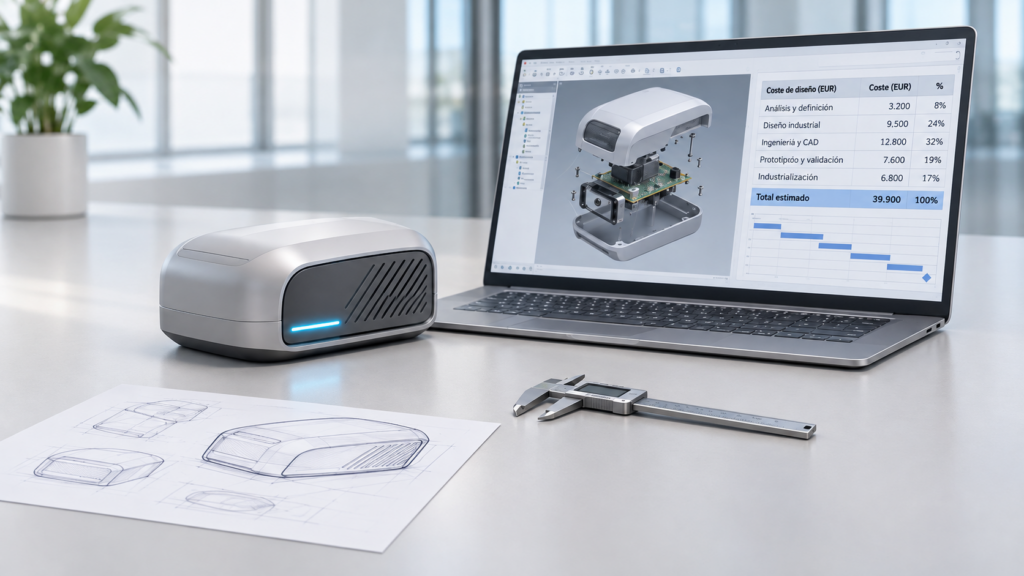
The budget follows the same phases as the development of any new product, and each one carries a different weight:
- Definition and viability: the cheapest phase and the one that shapes the most decisions. It sets requirements, target cost, volume and regulations.
- Concept and detail design: it usually accounts for most of the engineering hours, because this is where mechanics, electronics, interface and styling are resolved.
- Prototyping and validation: it combines engineering hours with external costs for manufacturing prototypes. Its cost depends on the technology chosen and the number of rounds.
- Industrialisation: adapting the design to the process, supporting the supplier and validating the first parts. This is where tooling comes in, which is usually the largest external item.
- Certification and pre-production run: tests, technical documentation and corrections. If something does not pass first time, the cost is repeated.
Some of those hours can be saved by validating digitally before manufacturing anything. Simulations, renderings and augmented reality make it possible to rule out options without paying for a prototype for each one.
The costs that are not design, but still need budgeting
These are the items that most surprise anyone developing their first product, because they do not appear in the design quote but they do appear in the project’s final bill.
Prototypes. The cost of a prototype depends on the technology (3D printing, CNC machining, vacuum casting, sheet metal), on size, on finish and on how many units and rounds are needed. A cosmetic prototype and a functional one that has to withstand real testing do not cost the same.
Testing and certification. Laboratory tests, technical documentation and, where the product requires it, CE marking have a cost of their own that depends on the applicable regulations and on whether the product passes the tests first time. Knowing the certification requirements and defining the test plan from the design stage is the best way to avoid paying twice.
Tooling. Series production needs moulds, dies or jigs, and their price varies enormously with volume and complexity. An aluminium mould designed for a short run has nothing to do with a steel mould built to produce tens of thousands of parts with complex geometry. That is why deciding the volume and the process early changes the total cost so much: it determines the type of tooling and, with it, one of the largest items in the project.
Why the cheapest quote can end up costing more
In our experience, cost overruns in a development project rarely come from engineering charging more than planned. They come from decisions that get paid for in later phases:
- A design that does not think about production. What is saved in design hours gets paid for in parts that are hard to make, slow assembly or moulds that have to be modified. It is the problem we described in from rendering to the final product.
- Changes after tooling. Changing a file costs hours; changing a mould that has already been made costs far more and lengthens the timeline.
- A brief that keeps moving. Adding a feature halfway through does not just add that feature: it forces a review of everything already done.
- Quotes that do not include the same things. One includes prototypes, iterations and documentation for manufacturing; another, only the design. The second one looks cheaper until it has to be completed.
- Ignoring the cost per unit. A few cents more per part, multiplied across the whole production run, can exceed the cost of the entire design.
It is the same pattern that appears in the critical mistakes that ruin a hardware development project: the problem is almost never the rate, but what was not decided in time.
How to ask for a product design quote you can compare
A good quote starts with a good brief. The more specific it is, the tighter the figure will be and the easier it will be to compare proposals:
- What the product has to do and for whom. Essential functions, desirable functions and conditions of use.
- Target cost per unit and expected volume. These are the two figures that most shape the design and the manufacturing process.
- Markets and regulations. Where it will be sold and which certifications it will need.
- Starting point. Sketches, previous prototypes, reference products or competitors.
- Timeline and key dates. A trade fair, a campaign or a launch date changes the plan.
And, when the proposals come in, it is worth asking for:
- A breakdown by phase, with deliverables and acceptance criteria for each one.
- What is included and what is not: number of iterations, prototypes, tests, documentation for manufacturing and support during industrialisation.
- How changes are handled outside the agreed scope.
- Who owns the design and the files when the project ends.
Product design and development at I-MAS
At i-mas we approach product design and development end to end, from definition and prototyping through to industrialisation and production, bringing mechanics, electronics, software and industrial design together under one engineering roof. Having every discipline in the same team makes it possible to think from the outset about the cost per unit and the manufacturing process, which is where a large part of a product’s total cost is decided.
Would you like to know more about our services? Get in touch with us or take a look at our projects!