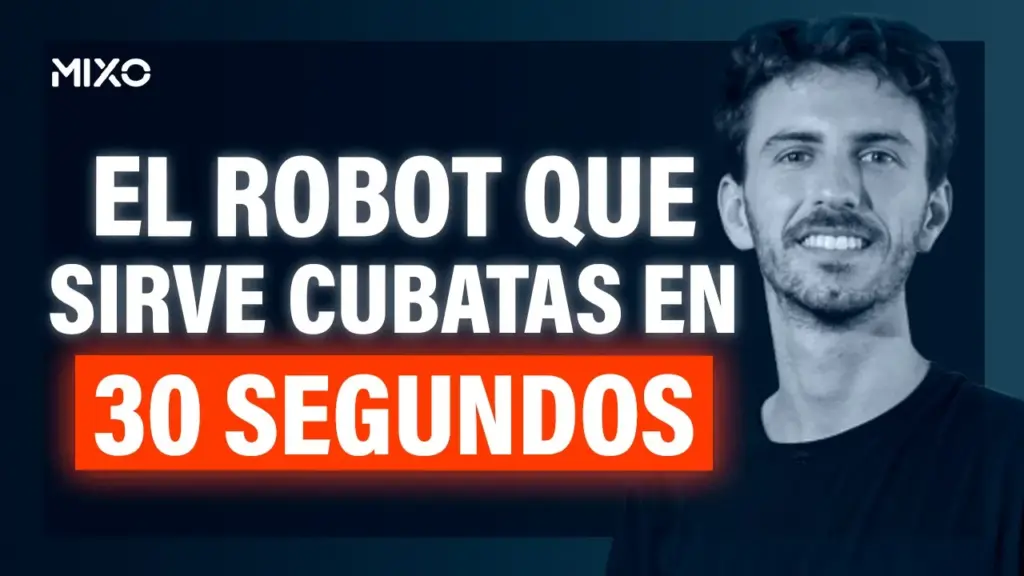
Developing a cocktail machine combines dispensing, interface design, payment and restocking within a service operation. In episode 3 of Toque de Ingenio, Martín Cohen, founder of MIXO, explains how his team designs a solution that both users and venue managers need to understand. The conversation follows its progression through successive versions to pilot trials in different settings.
Guest Martin Cohen. Company or organization: MIXO.
Interview published: March 18, 2024. Episode: 3. Duration: 1 h 8 min.
In this episode:
- How to integrate selection, payment, and dispensing for a seamless and complete experience.
- Why the worker’s role and the need for replenishment influence the design.
- What can be learned by testing the same equipment in different establishments.
Defining which part of the service you want to automate.
Martin presents a machine that allows for the selection and service of beverages through an automated sequence. The proposal focuses on the ability to handle a high volume of customers, consistent repetition of quantities, and a positive customer experience within the establishment.
The team needs to clearly define which tasks the machine performs and which operations remain the responsibility of the personnel. This division allows them to design the system within a real activity, rather than simply evaluating it during a demonstration.
La Industrial automation It provides a way to study those sequences: inputs, states, and expected results. The objective should be linked to the client’s operation and to the environmental conditions.
Dosage and user experience are closely linked.
The conversation describes the selection of a drink, the payment process, and the service provided. The total interaction time includes user decisions, as well as the mechanical operation. Measuring only the dispensing aspect leaves out part of the overall process.
La user experience and UX/UI design They should make it easier to understand the options and steps involved. The team needs to communicate what’s happening and when the drink is ready for collection.
The device thus integrates mechanics, electronics, and software. The functions must coordinate so that an action on the screen corresponds to a specific operation and a recognizable state of the product.
Also designed for those who restock and maintain.
Martin explains that the team considered both the person in charge of the premises and the customer. Restocking items and changing bottles should align with the activity of the establishment.
“We considered this from the worker’s perspective”.
Martín Cohen 20:29.
This priority alters the physical design. Access, identification of components, and the sequence of replacements impact equipment availability. An automated function may become useless if the supporting tasks are difficult.
In the product design, Maintenance and replacement procedures should be included in the specifications. These are interactions that are beneficial to test with the people who will be carrying them out during use.
Several versions to check the proposal.
The interview referenced several different versions of the product and testing at events. The team was learning about how it worked and how it was received as the system was taken out of the development environment.
Los functional prototypes They allow for the study of a function, but pilots add operational conditions. The user, the staff, and the pace of the place provide information that may require new changes.
Validation requires documenting what is being tested. A technical issue, a user interface question, and a commercial difficulty all require different responses, even if they arise during the same installation.
Comparing environments before scaling up production.
Martín explained the intention to distribute units across various types of establishments and to observe their behavior over a period. The company wanted to understand user and decision-maker responses before deciding how to approach another series.
“It needs to be tested”.
Martín Cohen 36:53.
The decision demonstrates that a product can have multiple potential applications. The pilots help to identify where it fits best and what conditions are required for each scenario.
Commercial learning needs to return to a developmental approach. If the way it’s used changes, the capacity, replenishment, or interface required could also change. Industrialization requires a sufficiently defined version for the chosen application.
The data can guide the service and its development.
In March 2024, Martín described plans to use sales data for forecasting local needs. The article maintains this function as a line being developed by the guest, without presenting it as currently verified capacity.
The concept allows for the identification of a product requirement: determining which data is recorded and what purpose it will serve. The capture should be linked to a practical question that the client can understand.
It’s also important to distinguish between an observation and a prediction. Historical data describes what has happened; a prediction needs to be verified before it can be used as a basis for further decisions.
Prepare the series while maintaining a connection with the user.
The transition to manufacturing requires documenting the version, its components, and the assembly operations. Any modifications arising from testing must be implemented in a systematic manner.
The interview reveals that hardware development continues alongside the start of commercial activity. The aim is to maintain a user experience and a service, as well as to create a functioning mechanism.
Questions regarding the development of a cocktail-making machine.
What should a dispensing machine incorporate?
MIXO allows you to observe how these elements – including mechanisms, control, selection, user communication, and replenishment operations – are related.
Why is it important to test the product in various environments?
Because users and operators can change. Pilots help to identify where a proposal fits and what requirements each application needs.
What should be checked before creating another series?
The usage data, any issues encountered, and the version that needs to be replicated. These changes must be reflected in the documentation, components, and assembly.
Four key takeaways from the chapter.
- The experience includes user decisions and equipment operation.
- The worker needs a clear and understandable replacement.
- Pilots differentiate between advantages and difficulties.
- The series should incorporate learning in a structured way.
From learning to product development.
At i-mas, we develop machines and products that combine mechanics, electronics, and interaction. If you need to automate a service operation or a dispensing process, We can help you define and validate the system..
You can also read. The development of ChillIt for on-demand cooling of beverages.
Source: Original interview from Toque de Ingenio, published on YouTube on March 18, 2024. The experiences, figures, and plans discussed in the interview are reflective of that specific time. The references to i-mas services are the editorial analysis of the article.