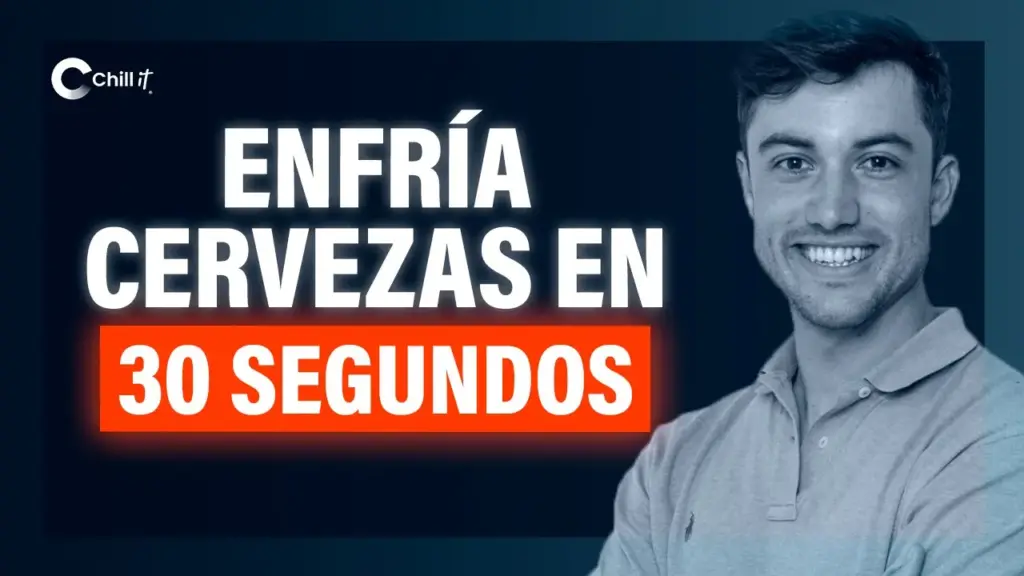
Rapidly cooling beverages requires coordinating refrigeration, packaging handling, and process control. Marcos Condomí, co-founder of ChillIt, explains in chapter 6 of “Toque de Ingenio” how the team evolved from testing initial concepts to a machine designed for on-demand consumption. The interview demonstrates why a new product needs to validate both its functionality and its role within a customer’s operations.
Guest Marcos Condomí Company or organization: ChillIt.
Interview published: April 12, 2024. Episode: 6. Duration: 1 h 4 min.
In this episode:
- How packaging and beverages influence the development of the machine.
- What did the prototypes and early commercial pilots teach us?
- Why manufacturing, maintaining, and transporting are also part of the product.
A consumer need is driving the initial proposal.
Marcos explains that the team faced difficulty finding cold drinks at the point of purchase. The proposal aimed to provide on-demand cooling, rather than solely relying on keeping all units refrigerated.
The interview describes how pilots revealed uses that went beyond the initial hypothesis. In supermarkets, some shoppers were cooling drinks to take them home, in addition to the immediate consumption that had been anticipated.
Learning for the product development It’s important to observe actual behavior. The initial design is based on a need, but market testing may reveal a different context of use that affects the proposal.
Rapid cooling of beverages under different conditions
Marcos points out that not all beverages and packaging react in the same way. Factors such as size, type of container, and the contents themselves are part of the process that the team studied during development.
“Each drink is different”.
Marcos Condomí 25:19.
The guest describes a cooling system and a specific cooling process, while deliberately omitting details. The article presents this explanation of how the system works, without specifying any particular times or guaranteed savings for any given scenario.
For engineering, the challenge is to define input conditions and the expected outcome. A test must specify which packaging is used, how the cycle is initiated, and what is being checked at the end.
The grip or handling of the packaging is a mechanical design decision.
The conversation dedicates a section to the gripping mechanism of the device. Marcos explains how the geometry of the grip determines what formats the machine can handle, and how new variations are studied.
Adapting requires more than simply stating compatibility with another container. The design must verify stability, movement, and the sequence of use within the overall system. A change can affect the mechanism and the cooling process.
Los functional prototypes These allow us to study these interactions before incorporating a variation into the manufacturing process. The article provides information about the mechanism and how the machine is used.
Years of testing to find a repeatable solution.
Marcos recalls a period of testing and adjustments where the team had to reassess strategies that weren’t producing the desired results. The development process took longer than a demonstration of the finished product might suggest.
“continue optimizing the process”.
Marcos Condomí 21:30.
The conversation indicates that development continues beyond an initial solution. Optimization requires identifying what needs to be improved and verifying that the change maintains the functions that were already resolved.
In a team that combines movement and control, the electronic integration It should relate to mechanics. The states, operating conditions, and user response are all part of a single architecture.
Scripts to understand the user and the business.
The interview places ChillIt in a phase of pilots and expansion as of April 2024. Marcos explains the commercial relationships and markets the team was exploring at the time, along with a collaboration with a manufacturer.
The installation should offer value to both those who use the equipment and those who maintain it within their business. The frequency of use, availability, and daily operation allow for a comparison of the benefits offered.
The subscription model described by the guest links product and service. The company must provide ongoing support and assistance during use, as well as deliver the initial equipment.
Preparing manufacturing and logistics prevents future difficulties.
Marcos recounted an incident that occurred when he sent a prototype to a trade fair. The planned transport didn’t go as expected, and the machine arrived after the event had finished. This episode demonstrates that a demonstration also relies on packaging, dimensions, and logistical coordination.
El industrial assembly And the handover process must include those operations. A machine needs to be removed from the development environment, delivered to its destination, and put into operation under the agreed conditions.
Learning the concepts within this chapter connects the entire chain: need, testing, manufacturing, and installation. Commercial experience helps to prioritize development, and technical knowledge allows us to uphold the product’s promise.
Questions about the rapid cooling of beverages
What variables influence the cooling of a drink?
In the interview, Marcos emphasizes the packaging’s content, size, and type. The process should be tested under defined conditions to verify the expected outcome.
Why might a new packaging format require changes to the manufacturing process?
Because its geometry alters how it is held and operated. The grip must be validated alongside the movement and the machine’s process.
What do pilots (or early users) contribute to a new product?
They allow you to see who is using it, for what purpose, and how it fits into the operation of the business. This information can modify priorities and previously planned uses.
Four key takeaways from the chapter.
- The packaging variables must be included in the testing process.
- The grip and the process both require joint validation.
- Pilots can reveal unexpected uses.
- Logistics and support are intertwined with industrialization.
From learning to product development.
At i-mas, we develop products and machines by integrating mechanical design, electronics, and prototyping. If you need to transform a process into a ready-made solution for manufacturing and use, Let’s talk about your project..
You can also read. Product design and automation with i-mas.
Source: Original interview from Toque de Ingenio, published on YouTube on April 12, 2024. The experiences, figures, and plans discussed in the interview are reflective of that specific time. The references to i-mas services are the editorial analysis of the article.