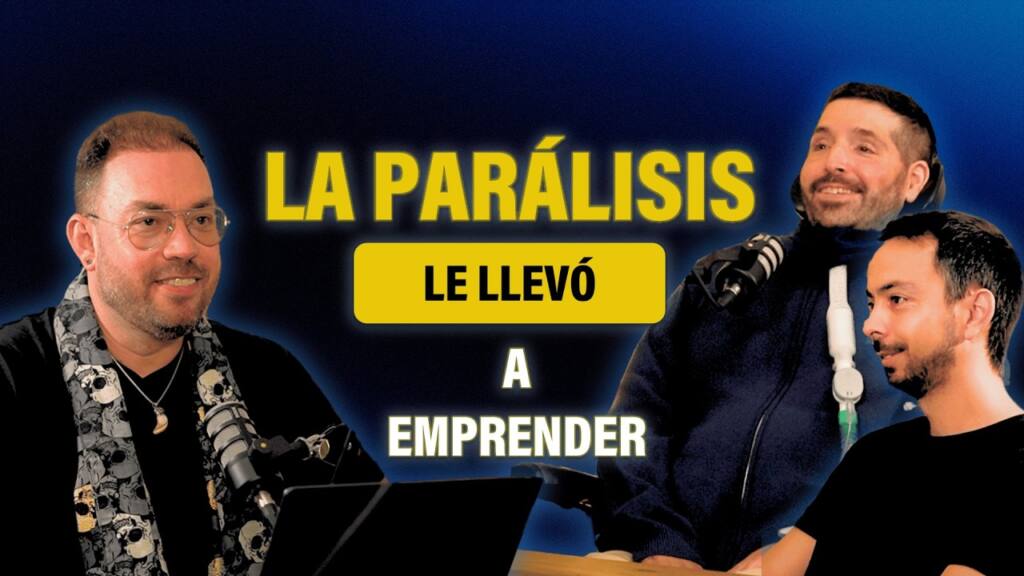
Controlling a mobile device without using your hands requires more than just moving a cursor – it also involves selecting items, navigating a page, and combining commands. In chapter 50 of “Toque de Ingenio,” Armando Folgado and Narcís Codina explain how Aurax addresses this problem with MouthX, an oral device that uses tongue and jaw movements. The interview showcases a product development process where accessibility, technology, and comfort are tested with the person who needs the solution.
Guests: Armando Folgado and Narcís Codina, the driving forces behind Aurax; Narcís is involved as the industrial designer for the project.
Interview published: May 13, 2025. Episode: 50. Duration: 1 h 11 min.
In this episode:
- How a daily need transforms into specific interaction requirements.
- Why MouthX combines a custom-fitted oral piece, electronics, and configurable controls.
- What do prototypes reveal about ergonomics, miniaturization, and user interaction?
Armando recounts how the loss of mobility has changed his relationship with activities he used to undertake regularly. These included communicating, studying, designing, and playing video games. The conversation reflects his personal experience and the state of development as of May 2025, before the commercial launch that the team was preparing.
Accessibility begins with a task that someone wants to reclaim.
The project’s origins stem from the meeting between Armando and Narcís, and from an initial, limited objective: to improve a control system that Armando was using. As they worked together, new needs emerged that went far beyond that initial mechanism. Being able to recover a specific activity allowed him to clearly see the limitations of the tools available to him.
Armando provided a very specific example: when controlling the computer with his eyes, simply looking at a text could cause him to stop reading. Another challenge was combining keyboard and mouse actions to use design programs. Being able to perform a single command didn’t solve all the tasks of a day.
Narcís interprets those difficulties as an issue of interaction: how many independent controls does the user need, and how can they operate them comfortably. This approach transforms a broad aspiration – to gain autonomy – into design decisions that can be tested using real-life scenarios.
For a team developing support technology, this case highlights the importance of considering the entire process. Writing a message, switching applications, or working with a program all require a sequence of actions. The quality of the product depends on whether that sequence makes sense for the user.
How MouthX works, according to its creators.
The team describes MouthX as a device similar to a splint, which fits over the top of the mouth. It incorporates controls for the tongue and jaw, and allows for the translation of head movements into actions on connected devices. The interview also covers functions related to head movement.
Using Bluetooth allows it to be used as an interface with devices such as mobile phones or computers. The movements can be linked to mouse, keyboard, or game controller functions. Configuration is important because different people and applications require different combinations.
Armando explains how he uses language to move the cursor and select items, while also assigning other actions to the interface, such as scrolling through the content. This example helps to understand the concept without reducing it to a single function. The user needs to be able to control multiple aspects of the interaction in a coordinated way.
Precisely, that possibility was one of the earliest considerations during the development process. Narcís summarized what they needed to verify:
“It is possible to coordinate tongue and jaw simultaneously”.
Narcís Codina 28:11.
The phrase appears when explaining the hypotheses that were intended to validate it. It does not mean to state that anyone can use the device in the same way – learning, mobility, and comfort all require individual attention.
Prototype separately to integrate later.
One of the challenges with MouthX is that the initial prototype couldn’t be simply solved by assembling large components within a casing. The working space is the mouth. Size, shape, materials, and protection of the electronics all condition the development process from its earliest stages.
Narcís explains that they conducted tests outside of the mouth to study the controls and prototypes without electronics, in order to assess the physical fit. Separating these tests allowed them to learn and understand before integrating all the functions. Afterwards, when all the components were combined, new problems related to actual use emerged.
Among the observations was the presence of saliva entering the device in some versions. This incident demonstrates how a functional test can prove an idea, while simultaneously revealing that further work is needed to transform it into a durable product. The behavior observed for a few minutes does not represent the entirety of the user experience.
The guests describe numerous iterations, parts and generations of prototypes. Beyond the numbers, what matters is what each cycle contributed: refining a movement, evaluating a shape or correcting an integration constraint. A programme of prototyping It’s useful when each version addresses a specific question.
Comfort demands designing with a specific person in mind.
The tongue and jaw possess different capabilities and sensitivities. As Narcís explains, learning to work with both required a reassessment of effort, routes, and control distribution. A solution that works effectively on a table may become uncomfortable when used in the mouth.
The requirement for use is stated very directly:
“that it can be accessed with the tongue and with the jaw”.
Narcís Codina 40:25.
For the initial version described in the episode, the team decides to personalize the piece based on a dental scan. This decision is intended to ensure a proper fit before attempting a more general solution. Personalizing the piece adds to the manufacturing process, but it addresses a key requirement of the overall experience.
It also changes the way validation is handled. Armando is familiar with all the different versions and has participated in the team’s learning process. Because of this, its creators explain the need to test the device with people who haven’t used it before. The team’s familiarity with their own product can mask potential difficulties with adoption.
The conversation highlights differences in adaptation times. This variation is valuable for design – it helps to review instructions, configuration, and support. The goal of accessibility encompasses not only how to begin using the tool, but also its capabilities once mastered.
Electronics, firmware, and equipment to turn an idea into a product.
MouthX integrates several disciplines. The mechanics need to house the controls, the electronics need to detect the actions, and the firmware needs to convert these into reliable commands. This is complemented by an application for configuring functions and devices. Each component must fit within the physical constraints of the overall system.
Narcís describes how specialized profiles and external support were integrated into the project. His experience in industrial design allowed him to cover several initial roles, but the project required additional expertise in electronics, programming, and industrialization. The composition of the team evolved in line with the complexity of the product.
The episode also demonstrates a focused approach. While they envision numerous uses, its creators acknowledge that presenting too many applications at once would complicate the launch and user experience. Defining a strong initial experience will help to streamline both the development process and subsequent service.
This relationship between functions, integration, and support is common in the development of electronics. A connected device requires a consistent journey from its initial setup to everyday use. Additional features add value when that core functionality is stable and can be maintained.
What can another development team learn?
- Translating a need for autonomy in tasks and observable action sequences.
- Separate the control tests, ergonomics testing, and electronic tests before integrating them into a complete prototype.
- Integrating new users into the validation process to identify challenges the team has already learned to overcome.
- Define the initial use and any necessary support before scaling up applications and functions.
Aurax promotes understanding accessible design as an ongoing collaborative effort between people, technology, and context. The value of MouthX is explained through specific activities that Armando is seeking to reinstate. If your company is developing a device where physical interaction is crucial, i-mas can help you transform those requirements into a product that can be tested, manufactured, and used. Please explain your project..
To continue reading: LUP’s AI text reader for people with low vision..
Source of article: An interview with Edgar Guerrero, featuring Armando Folgado and Narcís Codina, on Toque de Ingenio, published on May 13, 2025. The quotes link to the relevant sections of the video; the “learnings” are a summarized editorial version of the conversation.