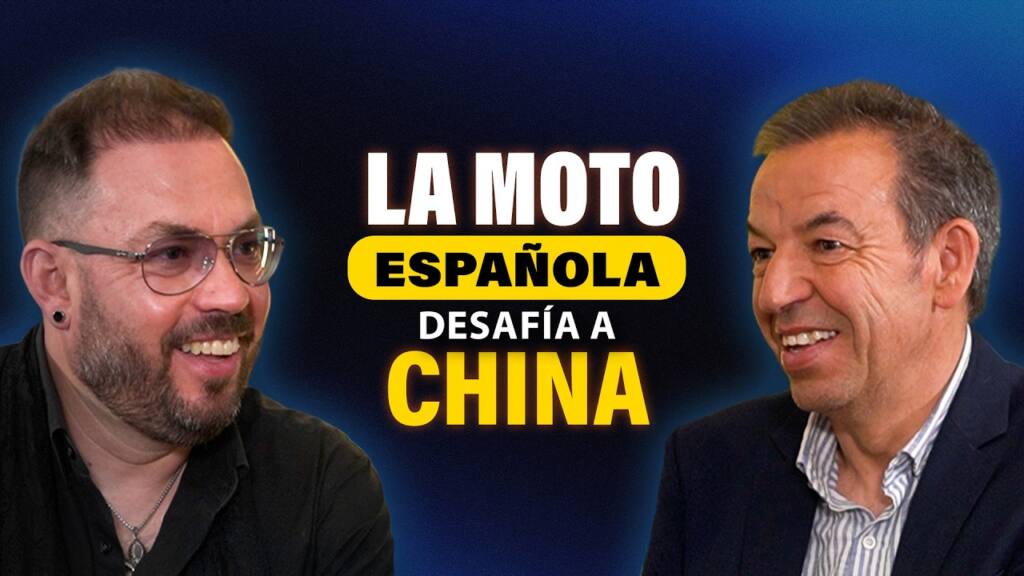
Manufacturing motorcycles in Spain has become an exception: most brands have either closed down or moved production to Asia. Rieju continues to manufacture approximately 20,000 units per year in Figueres, exporting the majority of its production, and is preparing a new factory. In chapter 53 of “Toque de Ingenio,” Álex López explains the decisions that have kept this family-owned company independent since 1934 and how it is approaching the transition to electric motorcycles.
Guest: Alex López, who was introduced in the episode as Rieju’s commercial director. Interview published: June 3, 2025. Episode: 53. Duration: 1 h 27 min.
In this episode:
- Why did Rieju outsource welding and presses following the 2008 crisis, and what did they gain from doing so?
- How the purchase of Gas Gas’s enduro platform opened up markets around the world.
- According to the manufacturer, what a user can and cannot do with an electric motorcycle.
The conversation was recorded near Barcelona, the day after Rieju presented his distribution network with new models boasting larger engines. Álex López has worked at the company for 26 years.
Eighty years of manufacturing motorcycles in Spain: from the motorized bicycle to three assembly lines
Álex recounts that Mr. Riera began in 1934 in a warehouse in Figueres, which the company still occupies, using oil deposits to create bicycle fenders. Riera and Juanola established their company in 1942, with documents signed by Salvador Dalí’s father, who was a notary. The brand name combines the first letters of the two surnames.
The first motorcycle arrived in 1947 and was a bicycle with a motor on the rear wheel. Of the over one hundred brands that existed at the time, very few remain, and Rieju stands as the last entirely Spanish manufacturer.
The guest doesn’t attribute survival solely to a single decision. Instead, they highlight the close relationship with the distribution channel and the ability to adapt to the market. Their flagship product remains the gear-change moped, where they claim to be number one in Europe.
Rather than pushing for a sale, it’s better to take care of the dealership and its customers.
Álex estimates that over 80% of his dealerships have been with the brand for more than 40 years. Faced with major brands pushing dealers to sell as many units as possible, Rieju tells him not to buy so many motorcycles if his market can’t absorb them. The dealership, he explains, isn’t for today – it’s for the coming decades.
That proximity also translates into product offerings. The configurator on your website allows users to choose colours, decals, suspensions, or seats, with over 100,000 possible combinations, according to their estimate, and the motorcycle is delivered in ten days.
The lesson is simple to state, but difficult to maintain: sell less today in order to preserve a healthy channel.
Emerging from the 2008 crisis by transforming properties into suppliers.
The recession caught Rieju by surprise, with several investments underway. They had developed an enduro motorcycle with Yamaha engines and an aluminum chassis, which was presented in 2007, and the market fell from 100 to 20 units in just three years. An electric scooter developed for the Generalitat (regional government), intended for 5,000 units for the police, was put on hold when the administration ran out of funds.
The response was to consolidate operations, and from 2010, to sell milling machines and welding equipment to its own employees, turning them into suppliers. Welding and presses were removed from the factory; internal machining is now a rarity. Alex acknowledges an added cost due to outsourcing, but in return, the structure is leaner, and the company adapts better to sudden market changes.
Edgar points out that the large industry has followed this path: to retain the core of the product and rely on more efficient specialists. The guest adds that this leads to a loss of control. It’s the balance that any company seeking to maintain production and assembly between our own resources and suppliers.
Finding the production volume that generates profit.
Rieju produces approximately 20,000 motorcycles annually, and has reached a peak of 23,000. They operate three production lines: one dedicated to electric vehicles, which currently accounts for 10% of production, and two for internal combustion engines. Typically, one or two lines are active; exceeding 20,000 units requires the third line to be activated.
That expansion comes with a cost that isn’t always apparent. Additional staff are sourced from temporary employment agencies, are less trained, and to maintain quality, it’s necessary to transfer permanent employees to the new chain. As Alex points out, the result is reduced profitability and increased guarantees. After two years, the extra motorbikes have performed less effectively than if we had remained at 19,500.
“It’s important to consider, at a business level, where you’re making the most profit.”
Álex López, 26:39.
When an order exceeds that threshold, the solution they suggest is to raise prices in order to curb demand, although recovering those costs later is also difficult.
Buying a platform to access markets: Gas Gas and the new engine.
Torrot, the owner of Gas Gas, sold the brand and its products separately. KTM acquired the brand name; Rieju acquired the enduro motorcycle platform. Alex explains that they were buying more than just a motorcycle: a product with a racing image and an international network that was already selling it.
The effect was swift. Rieju was exporting 70% of its production, and today it exports between 85% and 87%, with a presence in markets worldwide. From the outset, they knew they needed a new engine due to both regulatory requirements and the need to be competitive. The project began in 2021 and concluded in 2025, resulting in a two-stroke Euro5 Plus engine manufactured at their own facility.
The internal challenge was to change the sales mindset: moving from selling 50cc bikes to teenagers aged 14 to 16 to targeting enduro riders over 40. International expansion had begun earlier: they started in France in 2004 through trade fairs, using the initials RS because the name Rieju sounded Chinese. That is why their motorcycles carry the ‘made in Spain’ label.
Electric motorcycle: the difficulty isn’t in building it, but in ensuring the user knows how to operate it.
Rieju has been selling electric work vehicles for years, such as the Nuk model, which Correos uses as a delivery vehicle. During the interview, they presented 2,500 units. A year ago, they acquired materials from Ray, a company in administration, to incorporate the Ray 7.7 scooter, without purchasing the brand. They began manufacturing it using their own suppliers.
Regarding that scooter, Alex points out that it advertises a real range of 130 km, although the official figure is higher. He recommends subtracting a third from the official data and being transparent with the customer so they don’t feel disappointed.
Technically, he says that building an electric motorcycle isn’t excessively complicated; the tricky part is managing the batteries and the electronics that determine how much power is delivered to the motor. The difficulty lies in the buyer understanding what they can expect. He summarizes three rules: avoid leaving the vehicle unused for months, as lithium batteries degrade, use the middle mode to consume half the energy, and accept that it’s not suitable for everything.
Looking ten years ahead, I predict that leisure motorcycles will continue to rely on combustion engines, and urban mobility could become electric if prices fall.
Preserving knowledge in the face of globalization/dislocation.
Alex argues that offshoring seems like a straightforward solution: reducing costs from 100 to 80, leaving 20 in the company’s pocket. However, he maintains that after five years, the company has lost its expertise, and anyone can now produce the same products. He uses helmets and chips as examples.
“I believe it’s important that that knowledge doesn’t disappear”.
Álex López, 49:19.
The competition is part of that knowledge. The Dakar, which has been a part of the program since 2021, is primarily a branding exercise; the motorcycles set to be released are tested in less publicized races.
The growth plan is based on this foundation. At the time of the interview, Rieju had just presented his network with 500 and 700 models, as well as new 125s, and was beginning to build a new factory in Figueres on land purchased in 2007. The stated objective is to move from 20,000 to 50,000 units within approximately three years and to consolidate operations from eight scattered locations.
What can another development team learn?
The conversation with Rieju offers valuable lessons in industrial management that are applicable to other companies involved in the manufacture of:
- Understanding the profitable volume. More units don’t always equate to greater profit if they necessitate opening a chain staffed with temporary workers.
- Transforming the crisis into a network of suppliers. Outsourcing certain processes to former employees helps streamline operations while maintaining close relationships.
- Buying the market isn’t just about the product itself. A platform with a commercial network accelerates internationalization more effectively than starting from scratch.
- Explain the limits to the user. In a new product, such as an electric motorcycle, honest communication about range and usage prevents frustration.
At the time of the interview, Rieju was exporting over 85% of its production and was preparing for entry into high-displacement categories with a new factory.
This episode isn’t about a specific development, but rather about how a factory is managed over decades. If you work in industry and are interested in these kinds of conversations, follow Toque de Ingenio; And if you’d like to share how you make these decisions within your company. Tell us about your project..
To continue reading: Why do European hardware startups fail to scale as successfully as their American counterparts?.
Source of article: Interview with Edgar Guerrero on Toque de Ingenio with Álex López. The excerpts cited link to the minute of the conversation. The recommendations for other projects are an editorial summary from i-mas.