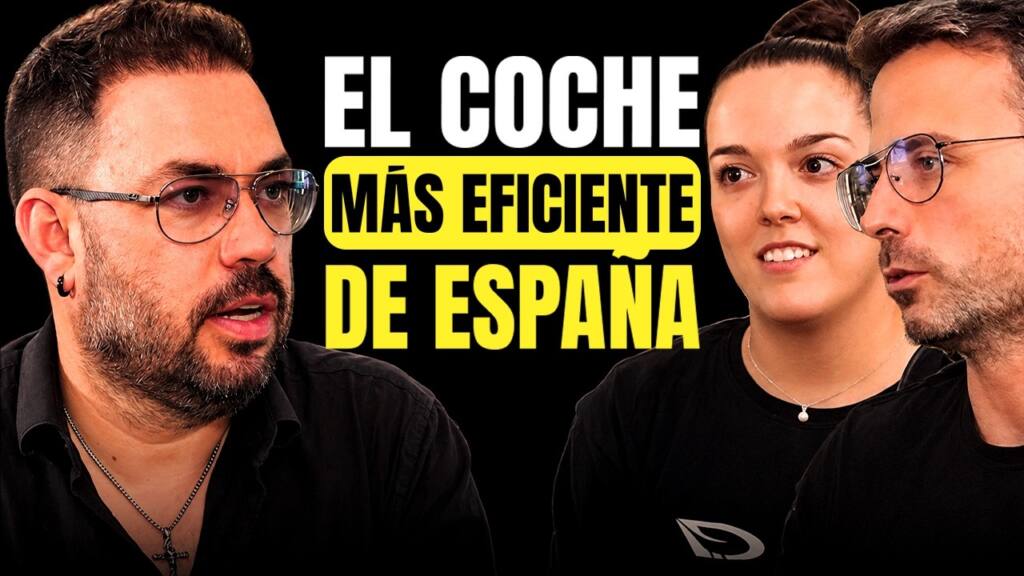
A self-driving car needs to know what’s in front of it, how far away it is, and the lighting and weather conditions it’s operating in. LiDAR measures this geometry using light pulses, but on its own, it doesn’t solve the problem, so it’s combined with cameras and radar. In chapter 70 of Toque de Ingenio, Santiago Royo explains how this technology works, its limitations, and how a university spin-off has transformed it into bespoke vision systems.
Guest: Santiago Royo, who was introduced in the episode as a co-founder of Beamagine and a professor of photonics. Interview published: December 9, 2025. Episode: 70. Duration: 1 h 10 min.
In this episode:
- What does LiDAR offer compared to cameras and radar, and what compromises does it require?
- Why fog and rain continue to influence where autonomous vehicles operate.
- How does one transition from a university patent to a company that designs vision systems?
At the time of the interview, Beamagine was approaching its tenth anniversary as a company. Santiago clarified that he was not acting as CEO – that role is held by Jorge Riu – but rather focused on business development.
How does LiDAR work, and what are the failures in cameras and radar?
Santiago describes LiDAR as a kind of camera that, instead of capturing light from its surroundings, emits a laser pulse and measures the time it takes for that pulse to return. This time is then translated into distance, and each pulse creates a point. The advantage over a traditional camera is the 3D capability: a camera projects the world onto a flat plane, while LiDAR directly returns volumes, distances, and shapes.
He explains that Beamagine’s system emits around 200,000 pulses per second, distributed across images of approximately 200 by 300 points at 7 images per second. A client in the space sector requested higher resolution at just one image per second.
LiDAR, it’s important to emphasize, is full of trade-offs. Achieving significant results requires more power in each pulse, but increasing power means a longer recharge time and fewer pulses per second.
Discussing the alternatives, he explains that radar produces false alarms around metal objects and offers low spatial resolution. Two-camera stereoscopy loses precision beyond a hundred metres and requires computation, whereas LiDAR provides a direct measurement. At night, the camera needs lighting and LiDAR performs better, because sunlight is its biggest source of interference.
Santiago’s conclusion is that the automotive industry needs a variety of imaging methods that can fail in different situations.
Range and resolution: 10 cm to 150 meters
Santiago has set the automotive standard at 150 meters – the distance a vehicle can stop on a motorway. At this distance, the system must detect any object taller than the bumper, approximately 10 centimeters in height.
“The real problem that hasn’t been solved is having technology capable of seeing objects 10cm in size from a distance of 150 meters”.
Santiago Royo 29:48.
The important point is that the range is insufficient. A single point 150 meters away doesn’t allow the software to make any decisions. There needs to be enough impact on the object – that is, a combination of spatial resolution and range.
The second issue is the cost. According to reports, a car camera costs around 5 euros, while manufacturers are requesting LiDAR sensors for approximately 1,000 euros, with the aim of reducing that price to 100 euros in the future. The optical technology needed to achieve this is still under research.
That discrepancy, in his view, explains why so many LiDAR companies have closed down in the last decade: the promise of a sensor in every car attracted investment, but the technology has developed more slowly than the business plans. Regarding Tesla, Santiago believes that they are optimizing their cameras while they wait for LiDAR at an affordable price.
Integrating LiDAR and cameras into a single, calibrated system.
Santiago identifies the success of Beamagine as providing the LiDAR alongside cameras. For every client they sold a LiDAR, they included a camera alongside it, so the team decided to integrate both into a single system.
Calibrating a LiDAR sensor with a camera requires testing with targets in various positions to ensure the two images align. A slight movement of the sensor, such as from a car, can cause misalignment and necessitate restarting the process. Providing the integrated system with a single cable eliminates this work for the software team.
Regarding sensor fusion, Santiago outlines two approaches. One uses an AI model for each sensor, combining the detections with rules: if two sensors detect something, it indicates a significant event. The other involves feeding a single model with all the data – this is an area of ongoing research.
Beamagine typically combines LiDAR and RGB cameras, and incorporates thermal imaging when it’s needed to see through fog. It’s a demonstration of Electronic engineering For any product with sensors: the architecture should anticipate how they are calibrated and maintained in alignment.
Rain, fog, and the autonomous car’s schedule.
The fog consists of suspended water droplets. When light passes through it, it disperses, and if it reaches the object, it has to return along the same path. The range of both the LiDAR and the camera is significantly reduced. According to Santiago, the rain needs to be very intense to have an effect.
Because of this, self-driving cars operate in San Francisco and Texas – warm, dry locations. In San Francisco, when it rains, the service sends the vehicle with a person inside. Waymo, with around 25 sensors, represents a maximalist approach; Tesla, a minimalist one.
Santiago also reviews the driving levels. Mercedes has certified Level 3, subject to strict conditions, which combines radar, LiDAR, and cameras. Their forecast, at the time of the interview, is that the robotaxi will progress rapidly if the regulations allow, while the widespread adoption of Level 3 in private vehicles is expected to take around 15 years.
Custom solutions: step-by-step, construction works, and space.
Beamagine offers a standard system, but according to Santiago, each client has a unique need. Underwater, the laser must be visible, not infrared. For a ground-level application, 150 meters is not required; a very wide field is sufficient.
The company adapts the optics, electronics, and mechanics of each variation based on what has already been developed. For standard applications, it recognizes that there already exists commercially available LiDAR, and there’s no point in competing with that.
One example is a workplace safety project on a large construction site. The 2D camera detected people and heavy machinery, while the LiDAR provided the actual distance and triggered an alarm when someone approached too closely.
Santiago mentions other growing areas: warehouse robots with single-line LiDAR, mapping with drones, and GPS-free navigation. The common factor is machine vision With real-time geometry, without any additional computation.
From a university patent to a spin-off.
Santiago worked at CD6, a research center from which several companies had already emerged. The team patented an invention related to LiDAR. The business plan ruled out the automotive industry due to cost and focused on defense, but a Swedish automotive company ended up purchasing the patent.
“It reaches levels close to the market, but it doesn’t go all the way through to the end.”
Santiago Royo 56:42.
With that statement, you describe the role of the university: creating a company is a natural next step in utilizing the results of research. A spin-off, you explain, typically arises from technology funded with public money, involving licensing agreements, university participation, and a royalty on sales.
Based on his experience, successful spin-offs involve separating a CEO from the business and a technical component that can remain linked to academia. He cites Beamagine as an example. Santiago estimates that there are around 200 spin-offs in Catalonia alone, although he believes that a cultural barrier persists in Spain when it comes to entrepreneurship based on science.
To anyone who’s questioning whether to take the leap, I advise them to decide how involved they want to be and at what pace they want to grow. And I recommend not going it alone – to rely on their own center, on accelerators, and on people who have already done it. Their biggest professional mistake, they confess, has been trusting the wrong people.
What can another development team learn?
The conversation with Beamagine has yielded four ideas for projects involving sensors and vision:
- Combine methods that fail in different situations. No single sensor covers every scenario; robustness arises from complementary redundancy.
- Design the calibration as part of the product. Integrating factory-aligned sensors saves the customer from a fragile and repetitive task.
- Do not confuse range with detection. A remarkable piece of data is useless if the software lacks the necessary resolution to determine its significance.
- To specialize in areas where the established standard doesn’t apply. When a commercial product exists, the value lies in adapting optical, electronic, and mechanical components to the specific situation.
At the time of the interview, Beamagine had been designing vision systems using LiDAR and cameras for the automotive, rail, space, and security sectors for almost ten years.
At i-mas, we have a team of machine vision specialists, and we know that the issue often lies in the lighting and environment, rather than with the camera itself. If your project requires integration of sensors, vision, or robotics, Tell us about your project..
To continue reading: Sensors and machine vision for safety in climbing..
Source of article: Interview with Edgar Guerrero on Toque de Ingenio with Santiago Royo. The excerpts cited link to the minute of the conversation. The recommendations for other projects are a summarised editorial from i-mas.