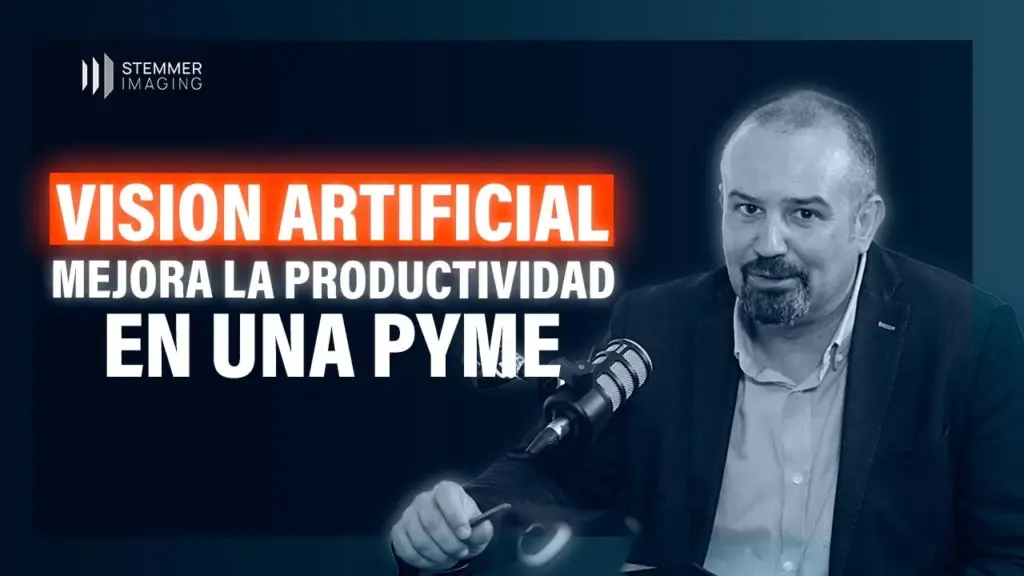
Industrial machine vision uses images to gather information and act upon a process. Juanjo Mañas, from STEMMER IMAGING, explains in chapter 14 of Toque de Ingenio how cameras, lighting, optics, and analysis – from inspection to robot guidance – are linked together. The interview helps to define an application before selecting components, and demonstrates why a single camera is not a complete solution for the entire system.
Guest Juanjo Mañas. Company or organization: STEMMER Imaging
Interview published: June 17, 2024. Episode: 14. Duration: 1 h 11 min.
In this episode:
- What components make up an machine vision application?
- How 3D vision can help locate parts for a robot.
- When does it make sense to study more specific capture technologies?
Obtain information from an image.
Juanjo distinguishes the image capture aspect of the analysis, which allows for a decision to be made. The purpose of the application is to gain relevant information about the product or scene – such as locating a component, identifying a characteristic, or determining how to orient an operation.
That starting point allows for the formulation of requirements. Before selecting a camera, engineering needs to understand what needs to be detected, under what conditions, and what will happen with the result. The vision system must respond to the task of the process.
La Machine vision and industrial automation. This approach connects acquisition, analysis, and control. A useful image isn’t just evaluated for its appearance, but for the consistent information it provides.
Camera, lighting, and optics work together.
The guest lists the components of an application: camera, lighting, optics, wiring, software, and processing unit. This selection is made as a complete set, as each element influences the image available for analysis.
“optical camera lighting”.
Juanjo Mañas 9:08.
A change in the environment can alter what is observed. Therefore, it’s important to study work samples and conditions, as well as the specifications of the components. The test should accurately reflect the difficulty being addressed.
The case proposes an integrative approach. The team doesn’t finish simply by selecting a catalog; they need to verify that the combination allows them to clearly identify the key characteristic within the actual process.
Industrial machine vision for guiding a robot.
The interview uses bin picking as an example: locating pieces placed in a container without a fixed order, so that a robot can collect them. Vision provides information about their geometry and position.
Juanjo explains how to use a point cloud and its relationship to the robot’s coordinates. Identifying a piece is part of the job – the trajectory and picking must align with the container and the feeding machine.
“a cloud of dots”.
Juanjo Mañas 18:26.
This example helps to understand the coordination between vision and robotics. The application should consider not only whether the piece is detected, but also whether it can be reached and manipulated in the intended way.
Choose the capture method based on the information required.
Juanjo evaluates applications across various sectors and comments on different capture technologies. The choice of technology changes when geometry, color, or another specific characteristic is of interest.
The conversation dedicates a section to hyperspectral imagery and examples of material identification. It highlights the learning process of determining what differences need to be observed and what techniques can be used to obtain sufficient evidence.
Not all projects require the most complex option. A case study helps to determine which technology is best suited for the situation and what remaining challenges need to be addressed. The comparison should be based on examples and criteria specific to the project.
Integrated processing and product development.
The guest also discusses integrating vision into smaller teams, a trend linked to new application possibilities. Analysis is no longer solely associated with large installations and can become part of a product.
La The electronics of a connected product. It needs to consider processing, feeding, interfaces, and space. If a camera is incorporated, its position and the conditions that will allow the scene to be observed must also be addressed.
References to trends and tools are from June 2024. The criteria for development that remains is to select an architecture based on its function and to verify its integration.
Demonstrate the solution and assist with its implementation.
When discussing markets, Juanjo emphasizes the need for technical support and demonstrating that a technology works effectively for the client’s application. The component gains value within a solution that is understood and can be utilized.
For an industrial company, that demonstration should allow for an assessment of the true difficulty. Representative samples, acceptance criteria, and observation of the process will help move from a possibility to a defined project.
The interview suggests considering machine vision as an applied engineering tool. The outcome depends on the coordination between image, algorithm, mechanics, and operation.
Questions about industrial machine vision
What components does an industrial machine vision system require?
The interview involves camera equipment, optics, lighting, cabling, processing, and software. The selection of these items depends on the specific information required by the process.
What is the purpose of 3D vision in robotics?
It can provide geometric information and positioning to locate pieces and guide a retrieval process. This information should be integrated with the robot’s coordinates and movements.
How to choose the right camera for a specific application.
First, we need to define what needs to be detected and to test representative conditions. The data capture technology must demonstrate that it provides the necessary information.
Four key takeaways from the chapter.
- The application is defined by the information it requires for the process.
- The quality of the capture depends on the optical system and the lighting.
- Vision and the robot need to have a consistent integration.
- Testing with samples allows for technology to be selected thoughtfully.
From learning to product development.
At i-mas, we develop solutions in machine vision and industrial automation. If you need to inspect, locate, or classify products We can review your application. and to define tests before closing the solution.
You can also read. Machine vision applied to order control using Bronze Tracker..
Source: Original interview from Toque de Ingenio, published on YouTube on June 17, 2024. The experiences, figures, and plans discussed in the interview are reflective of that specific time. The references to i-mas services are the editorial analysis of the article.