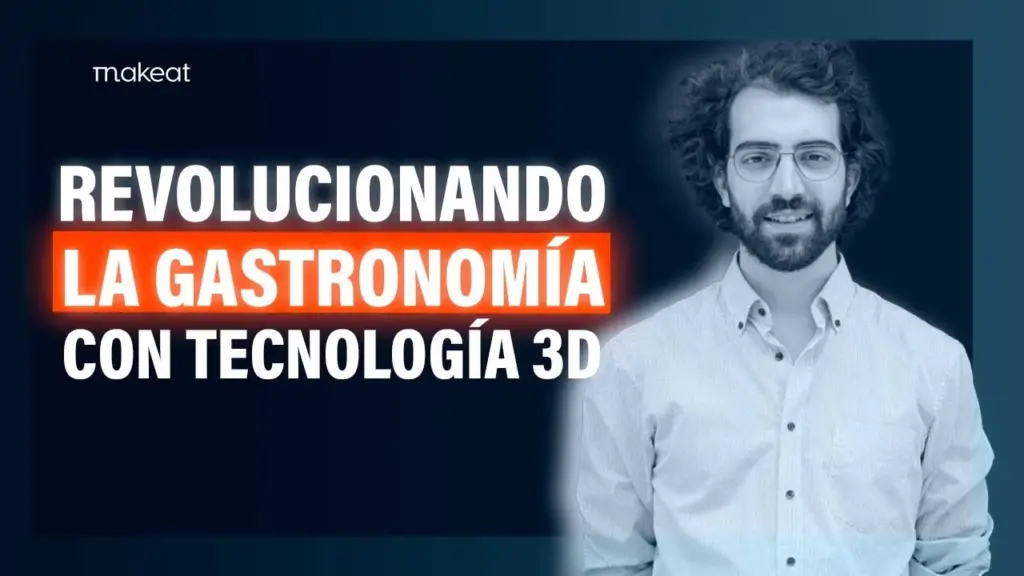
Gastronomic innovation often requires tools, molds, mechanisms, and manufacturing processes, in addition to a recipe. Adrià Colominas, co-founder of Makeat, explains in chapter 13 of Toque de Ingenio how he combines creativity, design, and technology to develop solutions in collaboration with chefs. The interview reveals why materializing and testing an idea fundamentally changes the way it is understood.
Guest Adrià Colominas. Company or organization: Makeat.
Interview published: June 10, 2024. Episode: 13. Duration: 1 h 28 min.
In this episode:
- How to connect the recipe, machine, and design from the outset.
- What do physical prototypes offer compared to a screen image?
- How to move from unique, one-off tasks to more repeatable products and processes.
Creativity, design, and technology centered around a need.
Adrià describes a career path that connects mechanics, digital manufacturing, and gastronomy. His experience with 3D printers and manufacturing spaces helped him understand tools that he later applied to other contexts.
Makeat was refining her proposal through both taking on assignments and learning. The guest explained that not all of the tasks provided the same value: repeatedly carrying out a specific customization could consume the time that the team needed to develop more complex solutions.
“Creativity, design, and technology”.
Adrià Colominas 19:32.
The focal point for product development It’s important to define which problem requires a specific solution. The manufacturing technology is selected after a clear understanding of the function and the experience we want to offer.
The recipe and machinery should be developed in a coordinated manner.
A passage from the interview explains how a variation in the recipe can resolve a mechanical difficulty. The viscosity or behavior of a mixture affects how it is moved or measured.
If the recipe and the machine are developed separately, each team can make decisions that hinder the other. Adrià suggests working on this relationship collaboratively in order to find a viable solution.
The same logic applies to other devices that manipulate materials: the mechanism needs to know what it’s processing and under what conditions. The interfaces between disciplines should be included as part of the specifications, rather than being discovered only during the final assembly.
Design an object that is part of an experience.
The conversation involves an exploratory menu presented through an object with various points of observation. The diner interacts with it to discover possibilities. The design plays a role in how the gastronomic proposal is understood and experienced.
The object requires a geometry, a scale, and a specific purpose. The experience of it goes beyond its appearance; it depends on how it is held, viewed, and interpreted within the context for which it was designed.
El User experience design This can also be applied to that physical interaction. Observing the person’s movement helps to determine what the object should communicate and what actions should be evident.
Prototyping allows us to move beyond the screen/display.
Adrià explains how a simple 3D prototype allowed them to review the dimensions and details of the object. Once it was materialized, the team was able to touch it and check aspects that were difficult to assess in the digital model.
“When things become reality, they are completely different.”
Adrià Colominas 38:06.
The guest uses the “screen effect” to describe details that seem relevant to expanding a design, but which are barely perceptible at actual size. A practical test helps determine where it’s worthwhile to focus effort.
Los functional and validation prototypes They don’t always need to fully solve the entire product. A simplified version can respond to a broad question, whether it’s about scale, handling, or comprehension, before utilizing a more comprehensive process.
Digital fabrication for specific applications
The interview explores molds, objects, and manufacturing resources, which enable the development of unique proposals. The usefulness of each tool depends on the desired outcome and the number of units being produced.
To industrialize, it’s necessary to consider repetition: how it’s manufactured, how it’s checked, and the amount of work required for each unit. The design can retain its unique character while also facilitating clearer operations.
In projects where equipment or a mechanism interacts with food, the Industrial automation It’s important to study the entire process. The recipe, the operations, and subsequent tasks all influence the technical solution.
Transforming project knowledge into a sustainable activity.
Adrià openly discusses the difficulty of maintaining a business that focuses on creating something unique in each project. In June 2024, Makeat was also exploring the possibility of selling its own products and establishing collaborations that could be repeated.
Reflection allows us to distinguish between creativity and operational procedure. Successfully completing a unique project provides learning; however, transforming a portion of that knowledge into a product requires documentation, production, and a clearly defined commercial proposal.
The guest concludes by highlighting the delegation and leadership as areas for learning. A team needs to share information and review decisions so that the outcome isn’t solely dependent on one person.
Questions about gastronomic innovation and product design.
What does industrial design contribute to gastronomic innovation?
It allows for the creation of tools, molds, mechanisms, and experiential objects. The interview demonstrates how function, manufacture, and intended use are related.
Why develop a recipe and a machine together?
Because the nature of the food affects the mechanism. A coordinated adjustment can prevent complications or resolve a processing difficulty.
What does a first physical prototype demonstrate?
Scale, handling, and perception, as well as specific functions depending on the test. Makeat uses simplified versions to determine what to improve before finalizing the design.
Four key takeaways from the chapter.
- The tool is selected based on the problem it needs to solve.
- The recipe and the mechanism share similar working conditions.
- The physical prototype reveals aspects that the screen hides.
- Repeating a solution requires organization in both production and knowledge.
From learning to product development.
At i-mas, we transform needs into products through design, engineering, and prototyping. If your project combines a mechanism, a material, and a user experience We can help you develop the whole thing..
You can also read. The development of the Kibus cooking robot..
Source: Original interview from Toque de Ingenio, published on YouTube on June 10, 2024. The experiences, figures, and plans discussed in the interview are reflective of that specific time. The references to i-mas services are the editorial analysis of the article.