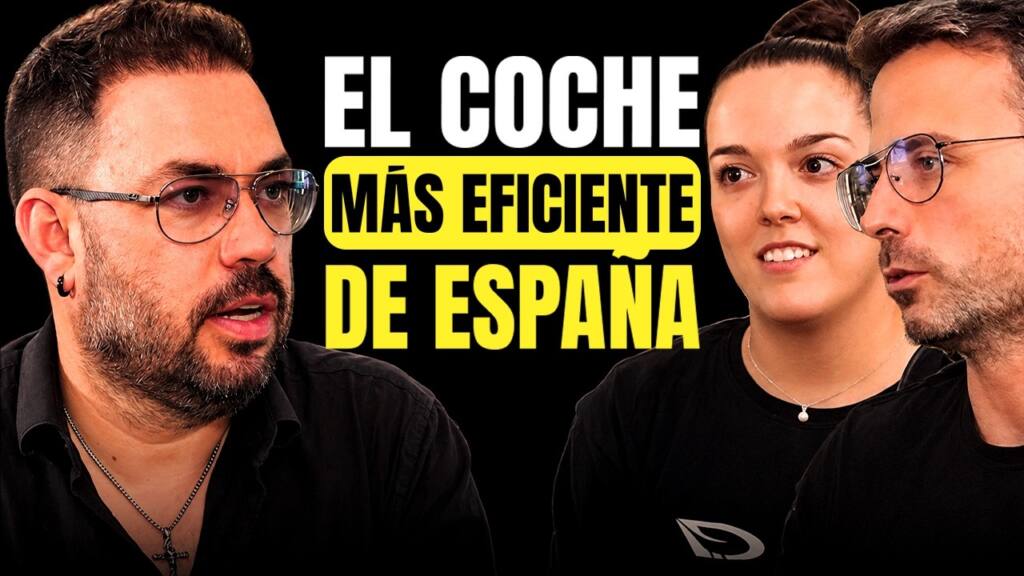
Cleaning without chemical products requires a disinfectant that works on dirt and disappears without leaving residue. Ecofrog has developed a system that takes oxygen from the air, converts it into ozone using an electric charge, and injects it into municipal water to clean professional kitchens, hotels, or elderly care facilities. In chapter 61 of “Toque de Ingenio,” Irene Santamaría explains how the system works, why they transitioned from importing a product to developing their own, and what it meant to have ozone certified as a biocide in Europe.
Guest: Irene Santamaría, who was introduced in the episode as the CEO of Ecofrog. Interview published: September 16, 2025. Episode: 61. Duration: 1 h 4 min.
In this episode:
- How is ozone produced from air, and why is water simply the medium through which it is transported?
- Why Ecofrog transitioned from distributing imported equipment to developing its own for the professional sector.
- What has hindered adoption: eight years of being classified as a biocide, and the decline of the French market.
At the start of the conversation, Irene mentioned that she was arriving in a hurry because the clients wanted the system installed before the holidays and the peak season for the hospitality industry. The interview was recorded, therefore, just before summer, with the equipment’s validation still in progress.
What is ozonized water, and how is it produced from air?
Irene describes ozone as a gas that naturally forms when lightning strikes the oxygen in the air. The Ecofrog team recreates this phenomenon using a generator based on the corona effect. When the user requests water, the machine takes water from the mains and oxygen from the air, applies an electric discharge, and separates the O2 molecules. These atoms are then introduced into the water, forming what Irene calls “trioxigenated water”—an unstable molecule that oxidizes any organic matter it encounters, or returns it to the air.
Because of this, ozone generated in air disappears almost immediately. When injected into water, Irene establishes its stability at five hours in a closed container and two hours in an open one.
“Water is the medium, and ozone is what acts”.
Irene Santamaría 07:47.
The team doesn’t filter anything, unlike an osmosis system. It simply adds ozone to the municipal water at a very small dose, between 0.5 and 1.2 milligrams per liter – a minimum effective dose to prevent problems with evaporation and to avoid any toxicity for those using it.
Cleaning and disinfecting without residue: what it does and what it doesn’t.
Ecofrog has specialized in the professional sector. Irene lists industrial kitchens, floors, glass, bathrooms, chambers, fryers and irons – in practice, any non-porous surface. The process involves two steps: first, it’s sprayed and cleaned to remove organic matter; then, it’s reapplied to disinfect.
What surprises clients the most, according to their accounts, isn’t the disinfection itself, but the degreasing ability. By spraying a range hood or oven, letting it sit for one or two minutes, and then wiping, the grease comes off as if using a surfactant.
It also highlights limitations: the system is designed for daily grease, and for barbecues with years of accumulated black residue, a more aggressive approach is needed. In the domestic version, connected to the washing machine, it recommends a little detergent for white clothes to counteract the oxidizing effect.
With these applications, Irene estimates a reduction in daily cleaning product consumption of 80 to 90%. In industrial dishwashers, where she believes the hospitality sector uses the most, the savings in detergent are between 70 and 90%. She considers this connector to be a unique development.
From imported products to equipment for the hospitality industry.
The project originated as a final assignment for an MBA program. Irene, who came from a sales background, remembered a similar system based on hydrogen peroxide and concluded that ozone was significantly more effective as an oxidizer. If she were to purchase the product, she reasoned, there would be many people in a similar situation.
The first step was distribution, rather than design. He brought an American product to Catalonia that did not work quite as expected, then found better equipment in China, which he imported and distributed for around five years for the domestic range.
When trying to enter the professional sector, that product wasn’t suitable: the dirt of a restaurant is not the same as the dirt of a home. They began to invest in R&D, he recounts. The hospitality-specific equipment was launched on January 20, 2020, just a few weeks before the lockdown.
Irene explains the shift towards B2B as a strategy for differentiation. In the domestic market, there was increased competition, and they couldn’t enter large retail outlets until ozone regulations were in place. In the professional market, there was no competition, but their product wasn’t reaching the market; developing their own product gave them a barrier to entry of one to three years. This journey, moving from distribution to manufacturing, is a common path towards Development of a proprietary product..
Equating ozone as a biocide: eight years and a lost market.
Irene explains that the process of legalizing a biocide typically lasts between one and two years, and that the “ozone” dossier, managed by an industry consortium, began in 2017 and remains open. On July 1, 2024, Europe approved ozone as an active biocide; now, the equipment is being regularized, and they estimate an additional two years.
According to her, the difficulty lies in the fact that the same file includes equipment like yours, with very low doses, and industrial generators for water treatment or food production. During the pandemic, large companies requested that it be included in the official list of biocides, a role it couldn’t have because the active substance hadn’t yet been approved.
The most difficult episode occurred in France, where a group of companies accounted for 40% of their revenue since 2020. According to Irene, from the INRS – a French labour safety agency – in September 2023, the sector was advised to stop purchasing ozonized water. Within fifteen days, sales in that country plummeted to zero, and this also affected the rest of the ozone companies.
The security testing of your team’s equipment was conducted specifically in a French national laboratory to avoid suspicion. Now, they are working with lawyers and with the consortium to claim compensation once final approval is granted. In Spain, they point out, they haven’t faced this issue.
Sell by demonstration: five critical points and five days of trial.
As the user sees the cleaning process, Ecofrog primarily demonstrates it. Irene describes the demonstration: the equipment is connected to a tap and a light point, the client washes their hands and notices the smell, and then selects five or six problem areas in their kitchen, such as the extractor hood or oven. During the final installation, a separate tap is identified as being treated with a biocidal agent.
For large kitchen dishwashers, the equipment is connected and left with the client for five days to allow them to check the consumption. The return depends on each individual client, but Irene estimates the payback period in the restaurant sector to be around twelve months, and in a three-person household, approximately 36 months.
“Ultimately, it’s not magic, it’s science”.
Irene Santamaría 44:10.
The primary risk she recognizes is human-related: staff turnover in the hospitality sector. To ensure that each new employee knows how to use the system, they’ve created QR codes that link to short videos. Many clients, she says, return after five years.
Internationalize and adapt: what Irene would do differently
Ecofrog began selling internationally by chance: during the pandemic, companies from the UK, France, and Italy contacted them, and they had to translate manuals and legalize the product in each country. Initially, the costs outweigh the sales, and it takes one or two years to implement the product in a market.
His advice is to have a clear plan before internationalizing, and to avoid improvising too much. He states that this improvisation is, as he responded to the previous question, his biggest professional mistake: launching a product for sale without having tested it, something that has helped him progress but also cost him money.
Regarding the most challenging aspect of the past ten years, Irene values above all the ability to adapt. “Ecofrog isn’t a startup,” she says, “but we’ve had to operate as if we were, because we couldn’t legally integrate into large corporations until 2024. Our stated goal is to see the team working in clinics and hospitals over the next ten years.”
What can another development team learn?
The Ecofrog case offers four key lessons for anyone developing a product intended to replace a consumable.
- Distribute before designing. Selling another company’s equipment reveals product shortcomings and which sectors are worth investing R&D in.
- To explain the regulation from the beginning. If the product is a biocide or an active substance, the application process may take longer than the development phase and restrict which clients it can be sold to.
- Design the demonstration as part of the product. When the result isn’t immediately apparent, a short testing protocol with key points selected by the client is needed.
- Predicting the usage cycle of the user. A simple system also requires repeatable training, such as videos accessed via QR codes, so that its use isn’t reliant on a single person.
According to the episode description, Ecofrog has installed over 60,000 units in 20 countries and works with Michelin-starred restaurants, hotels, and elderly care facilities. The process of certifying the equipment was ongoing at the time of the interview.
In i-mas, we develop equipment that combines mechanics electronics and control, and we prepare them for mass production. If your project replaces a chemical product with a physical process and requires prototypes, engineering, or industrialization, Tell us about your project..
To continue reading: How to develop a sustainable technological product and maintain it over time..
Source of article: Interview with Edgar Guerrero and Irene Santamaría on Toque de Ingenio. The excerpts cited link to the minute of the conversation. The recommendations for other projects are a summarised editorial from i-mas.