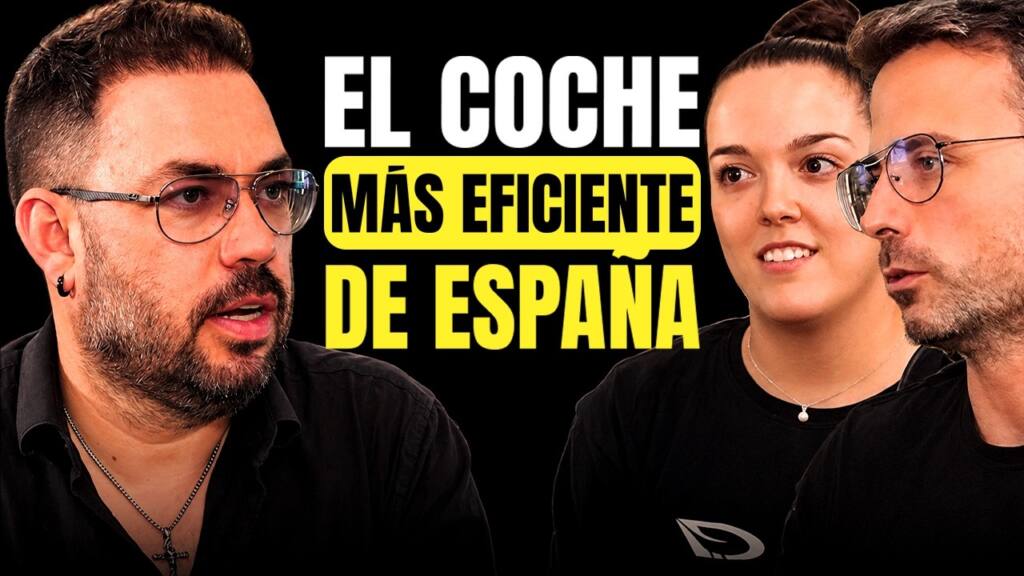
A cargo drone for logistics must fit into the supply chain as well as fly. Jakob Saalfrank, founder of Grasshopper Air Mobility, explains this idea in episode 45 of Toque de Ingenio. His project proposes combining air and ground transport with automated operation. The conversation explores how an ambitious concept is defined, what still needs development and why the business model shapes technical decisions.
Guest: Jakob Saalfrank, the founder of Grasshopper Air Mobility.
Interview published: April 8, 2025. Episode: 45. Duration: 1 hour and 14 minutes.
In this episode:
- How does a mobility project change when it’s focused on freight transport?
- Why the delivery, the energy supply, and the arrival at the warehouse are all considered part of the same process.
- What is the role of suppliers, prototypes, and funding in an aviation development?
The episode covers a project in development as of April 2025. The capabilities, timelines, and applications described by Jakob relate to his proposal and his then-existing roadmap. The interview does not present a commercial fleet that was already carrying out all those operations.
A concept of mobility that finds its application in logistics.
Jakob traced the origin of the idea back to his experience working in Austria, where even a short commute consumed a significant amount of his time. This situation prompted him to consider alternative methods of travel and the possibility of utilizing vehicles that were often left parked for extended periods.
Her experience in warehouse automation offers another perspective. When examining a supply chain, the problem encompasses scheduling, transfers, and coordination between different modes of transport. Simply increasing the speed of a vehicle doesn’t solve all of those time constraints.
Grasshopper’s proposal focuses on freight and industrial operations. During the discussion, the possibility of transferring cargo between locations and connecting the aerial route with access to facilities is explored. The logistics application allows users to formulate questions regarding routes and specific needs of a client.
For anyone developing a new product, this shift in focus is significant. A broad vision may require an initial use case that allows for the definition of verifiable requirements. The sector chosen determines what capabilities are needed, how the product will be used, and which people are involved in the purchasing decision.
The flight is a part of the supply chain.
Edgar raised a pertinent objection during the interview: combining air travel and autonomous driving adds complexity to a project that is already challenging. An alternative would be to land at a specific point and then use ground transportation to complete the journey. This raises the question of what value is added by integrating both functions.
Jakob is responding from the logistics coordination. If each arrival requires a separate vehicle or equipment to be waiting, transfers and times need to be managed by the system. His proposal aims to incorporate several parts of that route into a single solution.
The aim is summarized in an expression from the conversation:
“to consolidate everything on a single platform”.
Jakob Saalfrank 20:48.
The core of the issue is to make that decision clear. Integrating functions can reduce the number of steps involved, but it also expands the scope of the development. A team needs to assess whether the benefit to the client justifies the new technical and organizational dependencies.
Load and energy conditions influence the design of the system.
During the interview, a concept involving containers, including cargo and batteries, is explained. The aim is to allow for the swapping of modules to reduce the waiting time associated with recharging. In this approach, both the vehicle design and the exchange station design should work together seamlessly.
That detail shows that autonomy isn’t solely reliant on the onboard battery. It’s also important to consider how the next trip is prepared, where the exchange takes place, and what infrastructure is available at each end. The complete service needs to coordinate both energy and goods.
Jakob distinguished between electric vehicle proposals and research into hybrid alternatives, including hydrogen. These were areas the team was studying in response to operational and performance needs. The conversation revealed uncertainties and ongoing work, as well as aspirations for improved performance.
From the perspective of Industrial systems engineering, It’s advisable to treat these choices as related decisions. Increasing capacity or reach can alter mass, volume, cooling, and infrastructure needs. The architecture should be evaluated with a defined use case and testing that allows for hypothesis comparison.
Integrate available components and validate in stages.
One of the development criteria Jakob outlines is to utilize existing components whenever they can meet the project’s requirements. This strategy aims to focus effort on integration, rather than simultaneously undertaking the development of all the necessary technologies.
This approach also requires an understanding of the limitations of the suppliers. The availability of a component does not guarantee that it will function in any given configuration. The entire vehicle needs compatibility between systems, clearly defined interfaces, and testing under the intended conditions.
This episode outlines a scaled and progressively expanding prototype roadmap. Each version should enable the testing of new features and advance the development process. An initial physical representation communicates the concept; a functional test provides distinct evidence regarding its behavior.
For a program of prototyping, The lesson involves linking each stage to a question. This could relate to a movement transition, a module exchange, or the integration of a subsystem. Increasing size and complexity makes sense when the previous results justify the next step.
Who uses the system, and who operates it.
The conversation distinguishes between the company that needs to transport goods and the company that provides the logistics service. This is a significant commercial difference: the user of the transport capacity isn’t always the same entity that buys, maintains, or operates the vehicle.
Jakob is exploring the possibilities of selling, renting, and operating. When asked about the model, he indicates that:
“It also depends on the client”.
Jakob Saalfrank 47:16.
Operating the service would add to the capital and organizational needs of both development and manufacturing. Selling the equipment also involves other obligations, such as support, training, and maintenance. The choice made impacts the rate of growth and the resources the company requires.
The episode also addresses the difficulty of financing a project with multiple stages before widespread implementation. The technical roadmap should align with key milestones that facilitate securing resources. Clearly presenting what has been demonstrated and what will be tested helps to evaluate progress without confusing intention with actual results.
The same level of precision is needed when discussing savings for a client. Jakob explains that it’s necessary to analyze their specific supply chain. Comparing alternatives requires understanding the existing operation, its timings, and any limitations – a general promise is not a substitute for this work.
The comparison should also include how transport is handled today. Examining the costs associated with coordinating vehicles, transferring goods, and awaiting a new departure allows us to identify where the proposal could add value and what hypotheses require a pilot program.
What can another development team learn?
- Focusing a first use case to enable the transformation of a vision into operational requirements.
- Evaluate the entire system, including transfers, energy, and the necessary infrastructure.
- Combining available components with a specific validation of their integration.
- Distinguish between buyer, user, and operator to design a viable service model.
Grasshopper illustrates how complex development is approached when there are still hypotheses to verify. The interview proves useful in understanding the relationship between technical architecture, application, and resources. At i-mas, we help companies organize these requirements and progress through design and testing that provides information for decision-making. Tell us about the industrial challenges facing your project..
To continue reading: Embention’s autopilot systems for drones and autonomous aircraft..
Source of article: Interview with Edgar Guerrero on Toque de Ingenio, hosted by Jakob Saalfrank, published on April 8th, 2025. The quotes link to the relevant sections in the video; the key takeaways are a summarized editorial version of the conversation, and future goals are presented as project objectives.