El Development of a physical product with integrated electronics. It implies far more than simply designing each part separately. When electronics, mechanics, and software There’s a lack of coordination from the outset, leading to friction that often manifests as delays, redesigns, and increased costs in the later stages of the project. Conversely, effective coordination allows for risk reduction, improved product quality, and a faster time to market.
In this article, we explain how to approach a Multidisciplinary product development in a coherent way, integrating electronics, mechanics, and software As a single system from the earliest stages. A particularly relevant approach when working with custom electronics, Connected products or solutions designed for demanding industrial environments.
A product, three interdependent disciplines.
In current products, the electronics It’s no longer a standalone element. It conditions mechanical design, defines software capabilities, and largely determines user experience. Meanwhile, the Mechanical design imposes physical limitations on the hardware, to PCB design and the wiring, while the software depends on the resources and limitations of electronic system.
Understanding these dependencies from the outset is crucial to avoid partial solutions that work effectively on their own, but fail when integrated as a whole. A well-coordinated product is designed as a single system, not as the sum of independent disciplines.
Product and industrial hardware design and development – bespoke/customized.
Effective coordination begins with defining the product’s overall architecture. This phase involves deciding how the various functions are distributed. electronics, mechanics, and software, What elements are critical, and what levels of evolution does the system need to support?
When working with Custom industrial hardware, These decisions directly impact the size of the electronics, thermal dissipation, ease of assembly and maintenance, and the overall robustness of the system. Defining the architecture correctly from the outset allows us to anticipate problems and avoid costly redesigns in later stages.
PCB design and embedded firmware aligned with the product.
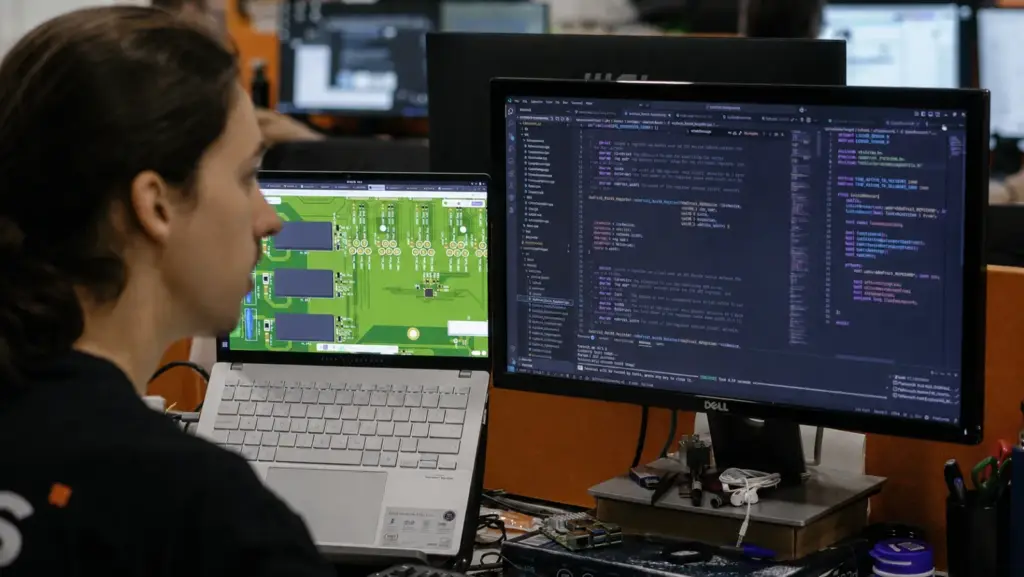
El PCB design It cannot be addressed in isolation. It must consider both the functional requirements and the mechanical limitations, as well as the expected product behavior when used in practice. Factors such as connector placement, mechanical fixing, and exposure to vibrations directly influence Electronic design.
In parallel, the embedded firmware It should be developed, taking into account the actual capabilities of the hardware and the needs of high-level software. Good coordination between firmware, electronics, and mechanics. Facilitates future updates, improves system stability, and reduces issues in production.
Electronic prototyping and integrated validation.
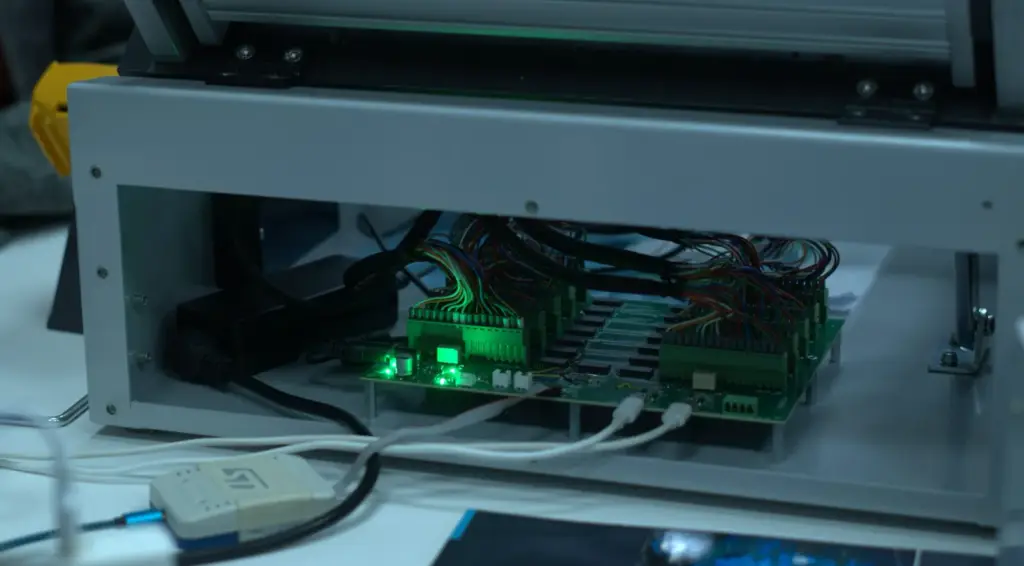
In well-coordinated projects, the Electronic prototyping, mechanic and software engineer The progress is made in parallel. The integrated prototypes allow us to validate not only that each component functions correctly, but also that the whole system works in a coherent manner.
This early validation is particularly important in solutions with IoT in industrial settings. o connected systems, where aspects such as consumption, communication, and on-field behaviour come into play.
Identifying incompatibilities at this stage reduces uncertainty and facilitates a smoother transition towards industrialization.
Connectivity and connected electronics
Increasingly, products are incorporating connectivity (WiFi, Bluetooth, LoRa, NB-IoT) As an integral part of their value proposition. To coordinate. electronics, mechanics, and software It’s crucial to ensure the stable operation of these technologies.
The placement of antennas, protection against interference, enclosure design, and firmware management directly influence performance. Connectivity. Poor coordination can degrade user experience or to create difficult problems to fix once the product is in production.
Thinking about electronic manufacturing and quality control.
Coordination between disciplines doesn’t end with prototype. In order for the product to be viable, it must be able to be manufactured, assembled, and tested efficiently. electronic manufacturing requires repeatable designs, clear processes, and defined criteria. electronic quality control.
Design with an industrial perspective. It involves considering from the outset how the assembly will be carried out, what tests will be applied during the process, and how product traceability will be managed. This approach reduces errors, improves process stability, and facilitates scaling.
Electronic certification and production.
In products intended for the market, the CE/FCC certification It should be taken into account from initial design phases. The coordination between electronics, mechanics, and software It’s crucial to meet regulatory requirements without making last-minute changes.
When these aspects are integrated effectively, the transition to a series is carried out with greater control and reduced risk.
I-MAS: end-to-end electronic development
In I-MAS Electronics We approach product development from a holistic perspective, offering end-to-end electronic development that combines electronics, mechanics, and software under a single engineering vision. We design Electronic solutions for industry adapted to real processes, from the initial definition through to production.
Coordinating these disciplines effectively isn’t just a technical matter; it’s a strategic decision. When electronics, mechanics, and software They work in alignment, resulting in a more robust, scalable, and well-prepared product for real-world industrial environments.
If your project requires a Custom industrial hardware o an electronic solution that combines performance, scalability, and design. I-MAS Electronics We’ll be with you throughout the entire process.
¡Contact us And takes the first step towards innovation!