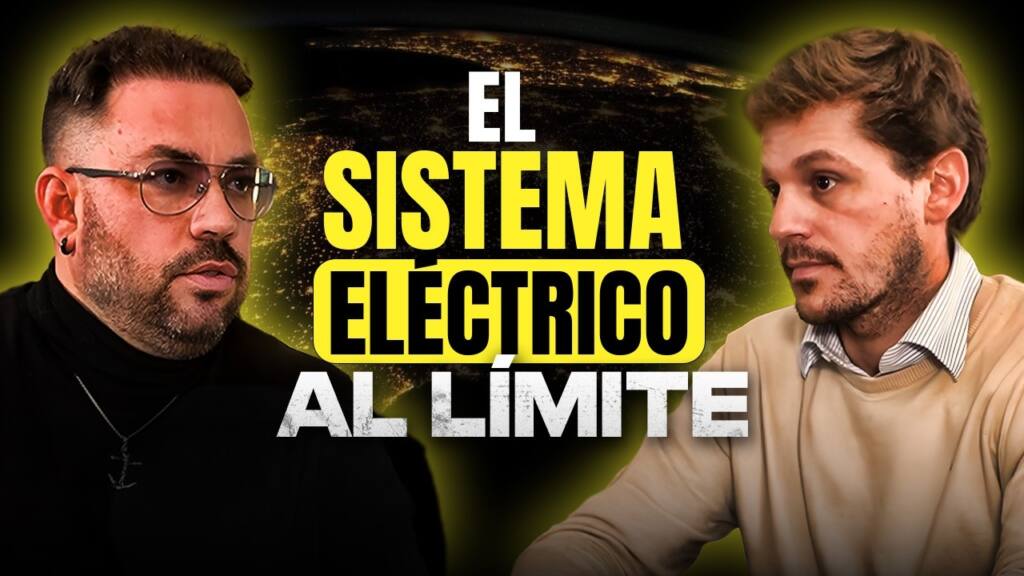
Understanding how the Spanish electricity system works is key to interpreting a company’s electricity bill, understanding the April 2025 blackout, and assessing the role of renewable energy sources. In chapter 77 of Toque de Ingenio, Marc Farriol explains how electricity reaches a factory, how the price is determined every hour, and why energy storage is the next crucial step.
Guest: Marc Farriol, who was introduced in the episode as the CEO of Audax Generación, the generation division of Audax Renovables. Interview published: April 28, 2026. Episode: 77. Duration: 2 h 5 min.
In this episode:
- Who generates, transports, distributes, and sells electricity in Spain.
- What was known about the April 2025 blackout, and why the inertia of the grid is important.
- According to Marc, batteries are the key element needed for renewable energy sources.
The conversation was recorded when Marc had been posting videos on his own channel for ten weeks, approximately one year after the outage. The first hour is dedicated to the electricity sector; the second hour focuses on his career, from intern to executive, and his decision to become active on social media. The figures and plans relate to the time of the interview.
Four officers between the plant and the socket.
Marc describes Audax as a trading company founded in 2009 in Badalona, which in 2016 acquired Fersa, a pure generation company, and consequently became a publicly listed entity. They supplied 16 terawatt-hours annually and generated half of that. The team responsible for generation, led by eight people, develops projects until they are ready for construction, commissions the work to external contractors, and then manages the assets.
Within the supply chain, there are four key players. The generators sell on a free market. Red Eléctrica transports electricity at high voltage, and one of the four major distributors brings the connection to the customer’s property; both are regulated and cannot be chosen. The energy marketer buys energy on the market on behalf of the client and sets the price.
From that division, two useful ideas emerge. The marketing company isn’t responsible for the quality of the supply; whether a cut is due to a storm or a power outage depends on the distributor. And physically, electricity arrives from the nearest plant, even if the contract is green – while origin certificates prevent selling more renewable energy than is produced, they are simply a financial mechanism.
How electricity prices are determined: the marginal market.
Marc explains that the pool is an hourly auction where the latest bid sets the price for all previous bids. The energy traders are offering at the maximum price, €3,000 per megawatt-hour at that moment, because they are obliged to supply to their clients, regardless of the situation. Nuclear power offers at zero because it cannot be stopped and started at will.
According to the report, the system is designed so that each technology aims to enter at the lowest possible price. A photovoltaic system is essentially just facing the sun, with very little variable cost, so it prefers to charge one euro to be excluded. Similarly, a wind turbine or combined heat and power (cogeneration) offer starting from their maintenance costs or opportunity costs.
That design explains what happened during the interview period. With a high amount of solar power generation and low demand for air conditioning, many hours of sunshine resulted in zero or negative production values. Because the producer is paid for these hours, Audax disconnects plants during those times. Therefore, they say, a small increase in gas prices barely affects the price of solar hours in Spain: the gas doesn’t even enter the auction.
For the trading company, the price for the pool represents a transfer. Marc states that the margin is agreed upon in euros per megawatt hour, not as a percentage, and that a fixed price for twelve months is always covered through futures or with own production.
Tolls: Why nighttime is so cheap on the bill.
Edgar presented the terms of his electric car contract, offering a very low nightly price and a significant penalty for using it outside of those hours. Marc attributed this to toll charges, not to the electricity itself. He explained that electricity was cheaper during the day, with rates of zero, and more expensive at night, at 150 or 180 euros per megawatt hour.
“The main difference comes from the toll/charge, not the cost of the energy”.
Marc Farriol 47:56.
The tolls compensate the distributor, and are set in hourly brackets as published in the BOE. They can vary by around 70 euros per megawatt-hour between daytime and nighttime. These were originally designed when demand dictated prices and the grid became congested during the day. Following the investment in renewables after the pandemic, the pricing pattern has changed, but the tolls remain the same.
Because of this, a practical rule exists: energy fluctuates daily, like a fluctuating price, but the toll changes at the designated time. Neglecting to adjust to the new time results in a costly toll.
The April 2025 blackout: what we know and what we don’t.
Marc admits that the exact cause was unknown at the time of the interview. He refers to a reported drop in power at a photovoltaic plant in Extremadura, but he does not confirm this. However, he explains the mechanism: electricity is produced and consumed simultaneously, and a mismatch triggers a chain of protective devices, such as the circuit breakers in a home.
The speed of that waterfall is related to inertia. A rotating generator, such as one used in a combined cycle or a hydroelectric plant, maintains a frequency during a period of inactivity, just like a car coasting in neutral continues to move. Photovoltaic and wind power systems are linked to that frequency, but they don’t generate it. On that particular day, most of the power generation was photovoltaic, and when one plant went offline, the next one couldn’t immediately fill the gap.
“Renewables themselves aren’t the problem”.
Marc Farriol 53:59.
Her conclusion is that a different technology requires a different approach to managing the grid. Following the incident, Red Eléctrica has scheduled more backup plants, which increases operating costs – a third component of the overall bill, alongside energy and tariffs. It responds that a country aiming for 100% renewable energy could function through grid-forming investors, providing frequency, but starting completely from renewable sources would be extremely challenging; therefore, the repowering was carried out on a plant-by-plant basis.
Storage with batteries: the missing piece.
For Marc, Spain has invested heavily in renewables and less in infrastructure. The bottleneck with a new park is administrative: it takes three or four years of paperwork, compared to one or two years of construction work. Photovoltaic and wind power depend on sunlight and wind, but batteries provide what’s missing – the ability to stop and start according to the grid’s needs.
He describes two benefits. First, smoothing prices: charging when the price is zero and feeding energy back when it is 180 brings production closer to consumption patterns and reduces what the customer pays. Second, stability: a buffer that stops supplying energy when the grid is saturated and contributes during a peak in demand.
At the time, investment in batteries in Spain was, according to his words, very nascent. There was a lack of a framework to compensate for backup capacity – like a firefighter being paid even when there’s no fire – because simply exploiting the differences in demand wasn’t enough to make the installations profitable. Audax was starting by installing batteries behind the meter to hybridize their plants and avoid lost revenue, rather than connecting them directly to the grid.
Facing hydraulic pumping, which requires two reservoirs, or the experimental use of hot sand, the battery in a container is the option with the highest density and the easiest to deploy, albeit with the drawback of lithium. No solution comes without a cost.
What does this entail for an industrial company?
Edgar recounts that he was negotiating solar panels for five ships, and that the installers suggested a 50% higher power output than the ships actually require, in order to sell the excess energy. Marc’s response is direct: “If selling energy isn’t your business, then size the system for your actual needs. And remember that the installers’ interest is to sell panels.” He adds that the energy trading company prefers a client who renews their purchases year after year, so advising them is part of their long-term business strategy.
The second notice concerns those who are expanding. A small increase in contracted power is a simple process; moving from 20 to 100 kilowatts requires action from the distribution company, which, according to Marc, could take two years due to a lack of capacity in the low-voltage network. Refer to clients who are using new facilities powered by a diesel generator because they still don’t have electricity. It’s advisable to request additional power as far in advance as the expansion itself.
What can another development team learn?
The conversation doesn’t describe a product, but rather a complex system, explained from within. Four ideas for other technical projects:
- Separate the price, toll, and operation. Before optimizing a bill or a process, it’s important to know which component is being changed and who is responsible for it.
- Size according to actual need. The supplier’s interest doesn’t always align with the client’s.
- Design for the technology available. A network heavily reliant on photovoltaics shouldn’t be managed in the same way as a network relying on turbines. The same applies to a production line.
- To be aware of and adhere to administrative deadlines. Permissions and connection points can take longer than the engineering and construction work themselves.
At the time of the interview, Audax Renovables operated in nine countries with around 800 employees and turnover approaching €2,000 million, with 100% renewable generation as its second business line. He says the company invests in proven technologies and was considering electric vehicle charging stations, with no decision yet made.
This episode is a discussion focused on the sector, rather than a report on a specific development. If you’re interested in interviews about industry, energy, and technology, please follow Toque de Ingenio; If you would like to continue the conversation Tell us about your project..
To continue reading: How to develop a sustainable technological product..
Source of article: Interview with Edgar Guerrero on Toque de Ingenio with Marc Farriol. The excerpts cited link to the minute of the conversation. The recommendations for other projects are a summarised editorial from i-mas.