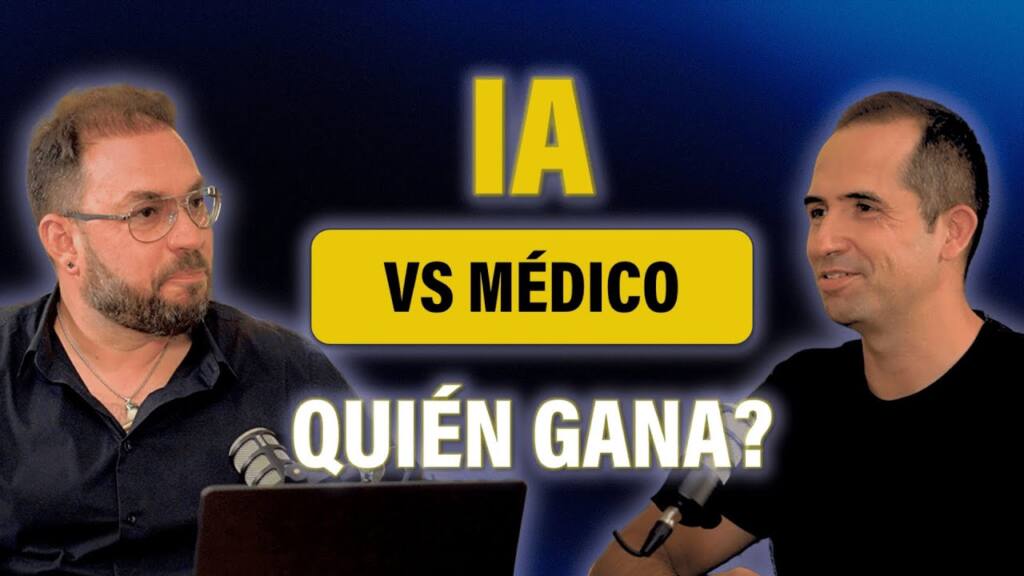
Artificial intelligence in medical imaging only becomes accessible to patients when it transforms into a validated, certified, and adopted medical product. Quibim, founded in Valencia, trains algorithms to extract biomarkers from MRI and CT scans, for detecting cancer, quantifying the liver without biopsies, and, in the long term, building a digital twin of the human body. In chapter 52 of “Toque de Ingenio,” Ángel Alberich explains how to define what an algorithm promises, with what data it should be trained, and why he stopped selling his first product.
Guest: Angel Alberich, who was presented in the episode as an engineer, founder, and CEO of Quibim. Interview published: May 27, 2025. Episode: 52. Duration: 1 h 30 min.
In this episode:
- Why an algorithm that has been tested in research doesn’t work effectively until it is manufactured and produced as a medical device.
- How to train cancer detection using biopsies instead of relying on radiologists’ opinions.
- What convinces a doctor and a manager to pay for an image analysis using AI?
The conversation was recorded during a visit by Ángel to the Sant Joan de Déu hospital, a client of Quibim, shortly after the company had completed a funding round worth approximately $50 million. At that time, the company was celebrating its tenth anniversary, and its prostate algorithm was already on the market.
From research to healthcare product: why an algorithm is not enough.
Angel studied Telecommunications, and as he recounts, he decided to apply signal analysis to the human body. He spent seven years researching within a private hospital group, where he met the radiologist with whom he would found the company.
The problem, essentially, is that none of the algorithms created at that stage ever reached a patient. They were designed for publication, but to be used in clinical practice, they needed to be approved as medical products. Ángel describes this approval process as more than just a list of requirements – it conditions how the model is trained and validated, and what responsibility the manufacturer assumes.
“Simply creating algorithms or code is not enough in the healthcare environment.”
Angel Alberich 14:08.
He explains that the hardest part of his ten years as an entrepreneur was discovering that turning research into a product was not 10% of the work, but 90%. Testing a model on three hundred patients at one centre was not enough: evidence had to be generated across different hospitals and countries. Ángel compares it with manufacturing, even though the product is software.
Define what the algorithm promises before training it.
According to Ángel, the key to any medical device company is to define, from the outset, what the product will do and who will use it. In medicine, this translates into “claims”—stating that an algorithm detects, diagnoses, or predicts—which completely changes the development and validation strategy.
Quibim developed prostate cancer. Ángel cites that the world’s leading radiologists detect the cancer in MRI scans in 79% of cases, with a specificity rate between 40% and 45%. The aim was to improve sensitivity without increasing false positives, avoiding what he calls a “Christmas tree”: an image filled with false alarms that the doctor ends up ignoring.
The central decision involved determining what “truth” to train the model on. If the data is based on the expertise of radiologists, the model will perform as well as they do. Quibim linked thousands of MRI scans with biopsies taken from those same patients – which is what regulators require. The model learns, based on the pixels, what the biopsy will look like.
Ángel states that his research indicated more than a 10% improvement in sensitivity, without increasing false positives, and a 99% negative predictive value. He emphasizes that this data is significant in screening: if the image shows no abnormalities, the system avoids recommending a biopsy. He adds that, at the time of the interview, only Quibim and Siemens possessed that certification for prostate examinations.
Virtual biopsy and digital twin: how far can imaging go?
In addition to prostate health, Quibim offered products for brain health and for metabolic diseases of the liver, where it measures fat and iron levels. Ángel explains that the coexistence of these conditions is a risk factor for liver cancer, and that monitoring this with repeated biopsies introduces a risk of infection. The virtual biopsy replaces the needle procedure with a measurement taken during an MRI scan, although he insists that for cancer, the biopsy will remain the standard technique.
A design rule applies to all products: an algorithm intended for routine clinical use should function with the minimum possible data, as a hospital in another country may not collect the specific clinical data required. Relying solely on images makes the solution scalable.
The digital twin is a long-term ambition, inspired by engineering. Ángel acknowledges that the human body spans too many scales for Quibim to address them all. His role is the image: a full-body scan that already measures body composition, liver fat, or lung injuries, presented as a form of self-backup. He anticipates this will be available within the next five to ten years.
Obtaining clinical data: ethics committees, biobanks, and image quality.
Edgar raises the classic problem of deep learning: there’s a significant lack of data, and much of it is private and sensitive. Ángel responds that the initial step involved a methodology for presenting research projects to the ethics committees of hospitals. In each project, the data is centralized, the models are trained, and then they are brought to market.
Meanwhile, Quibim argues that the data should be stored in biobanks. Ángel cites the US TCIA report and the European project ‘Cancer Image Europe’, involving 76 partners and aiming to collect data from approximately 100,000 cancer patients, where Quibim is the company with the largest budget.
The data is also not consistent. The algorithm needs to function anywhere in the world with images from Philips, Siemens, Canon, or GE, so the company has invested in harmonizing images using generative AI and quality control. Edgar recalls that in the projects machine vision at i-mas, the first question asked of a client is how many images they have; Ángel confirms that the same applies at Quibim.
Clinical adoption and economic model: convincing the doctor and the manager.
Angel explains that the statistics weren’t proving anything. The turning point came when the doctor saw the algorithm successfully resolving specific cases, including cases where he himself had made an error. There were radiologists who went through the model and saw a lesion that they hadn’t detected in an earlier scan.
What was most challenging during the interview was the economic model. Quibim sells to hospitals on a subscription basis, depending on their size. The managers compare the cost of the analysis with that of a scan, and Ángel responded that the correct comparison is with a biopsy, radiotherapy, or medication. He cited a 30% rate of unnecessary biopsies.
In the United States, doctors have more decision-making power, and centers are quicker to adopt new technologies; in Europe, decisions are more dependent on managers. The American challenge is reimbursement, which requires demonstrating that the test saves costs for the system.
Stopping the sale when the product isn’t ready.
Quibim was good at creating products and certifying them, but, according to Ángel, they hadn’t established a sales structure. In medicine, marketing is a one-shot deal: if you fail, the doctor won’t trust you again. The initial version of the prostate product analyzed the gland, but during the first implementation, the doctor asked where the lesions were.
“We decided to stop, rather than trying to sell anything, and to invest more in product development”.
Angel Alberich 76:42.
Adding lesion detection represented a significant scientific challenge, but they developed it before reselling it.
The $50 million round of funding is earmarked for that phase. Ángel estimates that a validation study in the United States will cost around two million euros, and a new product, between three and four and a half million. The cited plans involve lung, breast, and autoimmune diseases.
What can another development team learn?
The Quibim case offers four key lessons for anyone developing software or devices that require clinical validation:
- Establish the “claims” first. Detecting, diagnosing, or predicting are distinct processes, each requiring different data, validation, and regulatory oversight.
- Train with the source of truth. Labeling with experts restricts the model to the level of the experts; a biopsy or actual result allows us to go beyond that.
- Design for the minimum data. An algorithm that requires data not collected by all centres is not scalable, and the heterogeneity of the machines is managed within the product itself.
- Do not sell before time. In a market where trust is quickly lost, stopping sales could be the decision that saves the product.
At the time of the interview, Quibim had products for prostate, brain, and liver on the market, had licensed Philips’ prostate algorithm (without exclusivity), and was preparing new developments following the recent funding round. The figures and plans relate to May 2025.
At i-mas, we develop machine vision systems and electronics For teams working with image capture and processing. If your project requires integrating cameras, sensors, and algorithms into a device that needs to be validated in a demanding environment. Tell us about your project..
To continue reading: How is a medical electronic product developed, and what does its regulation require?.
Source of article: Interview with Edgar Guerrero on Toque de Ingenio with Ángel Alberich. The excerpts cited link to the minute of the conversation. The recommendations for other projects are a summarised editorial from i-mas.