Most conversations about industrial automation start with the equipment: a robot, a cell, a camera. And hardly any of them start where they should, which is the process about to be automated and the actual state it is in.
That is what a process audit before automating is for: understanding what the plant does today, with how much variability and with what data, in order to decide what is worth automating and in what order. It is not a formality ahead of the project: it is the part of the project that determines whether the rest goes well.
Automating a process you do not understand does not improve it, it freezes it. The machine will execute precisely what it has been told to do, including the decisions an operator makes today without anyone having written them down.
What a process audit before automation involves
It means walking the whole production process as it works today and documenting it: the sequence of operations, the real cycle time of each one, manual interventions, acceptance criteria, variability of the incoming product, how often the format changes and what happens when something deviates.
The output is not a descriptive report but a list of decisions: where the real bottleneck is, which operations are candidates for automation, what requirements an automated system would have to meet and what would have to change in the plant before installing it.
Measure before automating: real data, not impressions
Where time is lost on a production line almost never matches where people think it is lost. That is why the first job is to quantify: effective throughput against nominal throughput, stoppages and their causes, scrap, rework and changeover time.
Indicators such as OEE exist precisely for that: separating how much is lost to availability, how much to performance and how much to quality. It is worth measuring before the investment, because without a baseline there is no way to demonstrate afterwards what the automation actually delivered.
And it is worth measuring on real production, with the usual product mix, not on the easiest reference. It is the same logic that explains why so many automation projects fail: the sizing was done with the favourable case.
Stabilise the process before automating it
A manual process absorbs variability without anyone noticing: the operator compensates for a part that is out of tolerance, adjusts by eye, sets aside whatever does not fit. An automated system compensates for nothing that has not been anticipated, and every exception turns into a stoppage.
Which is why much of the preparation is not technological. It involves bounding the variability of the raw material, setting measurable acceptance criteria, organising how parts are fed and positioned, and writing down what is currently tacit knowledge held by the shift.
Review safety: automating can change the CE marking
This is the point that causes the most surprises. Adding a robot or a new station to an existing line may constitute a substantial modification: a change not foreseen by the manufacturer that creates a new hazard or increases a risk to the point of requiring different guards or protective measures.
When that happens, the result has to comply with the legislation as a new product: risk assessment, technical file, EU declaration of conformity and CE marking. On top of that, integrating several machines so that they function as one can create an assembly of machinery that must be CE marked as a whole, with the integrator taking on the role of manufacturer.
There is also the regulatory calendar: Regulation (EU) 2023/1230 replaces Directive 2006/42/EC and applies from 20 January 2027. Any project installed over the coming years is worth planning with that framework already in view.
Data, traceability and integration with plant systems
An automated cell generates information: units produced, rejects, stoppage causes, process parameters. If it is not defined from the outset who collects that data, where it is stored and in what format, the installation ends up working as an island.
So the audit also has to look at the infrastructure: what the current PLC controls, what communications exist, whether there is end-of-line traceability and how far the data processing is meant to go, both in the plant and at the edge of the machine.
What to automate first and what to leave alone
Not every operation pays off. The ones that respond best to automation are repetitive, with objectively definable criteria, controlled input and stable volume; the ones that respond worst depend on human judgement in the face of high variability or change format constantly. That analysis is what determines which industrial tasks make sense to robotise and which are better left as they are.
When the plant runs many references, the question changes: it is not how much you automate, but how much flexibility you need to buy, a key criterion in multi-product lines. And before installing anything, simulating the cell with a digital twin makes it possible to validate throughput and interferences on a model instead of on a stopped line.
How we prepare a plant before automating at I-MAS
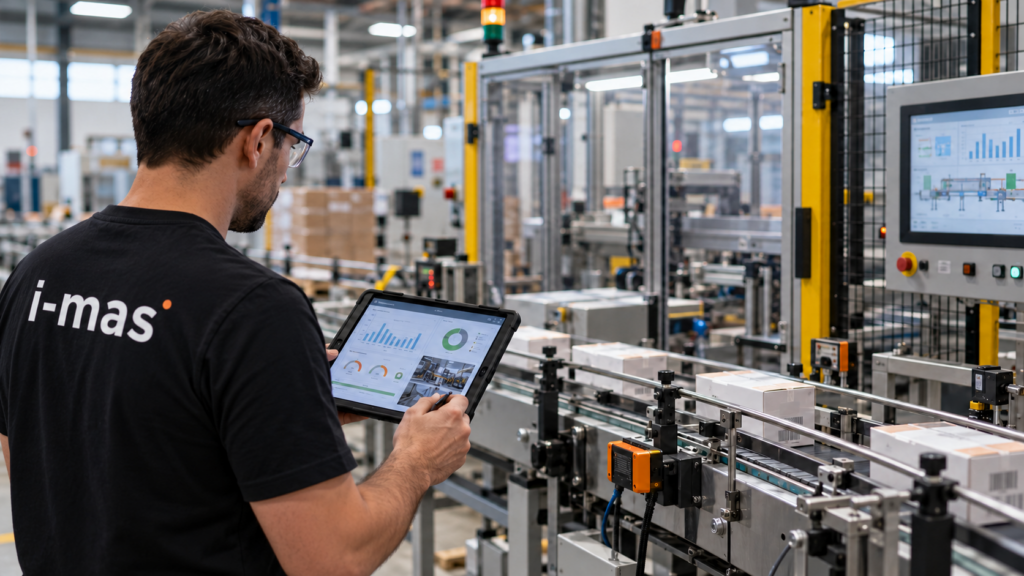
At I-MAS we approach industrial automation projects by starting with the plant rather than with the catalogue: we measure the process, identify the real bottleneck, agree measurable acceptance criteria and review the machinery safety and regulatory implications before proposing a solution. We then design the cell, the mechanics, the electronics and the software as a single system.
Would you like to know more about our services? Get in touch with us or take a look at our projects!