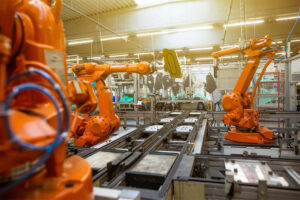
Industrial robotics has been present in factories around the world for decades. However, the current debate no longer revolves around whether it makes sense to robotize, but rather which industrial tasks it makes sense to robotize today, under what conditions, and with what objectives. Not all operations benefit equally from robotization, and a poor choice can lead to greater complexity, unnecessary costs, or solutions that are difficult to maintain.
In this article, we analyze, from a practical and plant-oriented perspective, which industrial tasks are truly suitable for robotization, taking into account current technological maturity, process variability, and actual production needs.
How industrial robotics has evolved in recent years
For a long time, industrial robotics was associated with highly repetitive tasks, stable cycles, and large production volumes. Isolated robots, always working on the same part and with few variations. That scenario is still valid in many cases, but it no longer defines the full potential of today’s robotics.
Today, advances in control, sensorization, artificial vision, and integration with automation systems make it possible to tackle more complex tasks with greater variability. This does not mean that any process can be robotized, but rather that the range of industrial tasks that can be robotized in a meaningful way has expanded significantly.
Repetitive tasks with high physical demands and low added value
Tasks involving repetitive movements, load handling, or awkward postures remain prime candidates for robotization. In these cases, industrial robotics brings immediate value not only in terms of productivity, but also in terms of ergonomics and occupational risk reduction.
Operations such as palletizing, loading and unloading machines, handling heavy parts, or internal transfers are clear examples where robotizing industrial tasks offers measurable benefits from day one and a relatively quick return on investment.
Industrial processes with clear and repeatable criteria
When a task can be defined by clear rules, well-established tolerances, and stable work sequences, robotics is a natural fit. These types of processes allow for the development of robust, reliable solutions that are easy to maintain over time.
In these cases, programming is simpler, the need for continuous adjustments is reduced, and high levels of availability in production can be achieved. That is why many classic industrial automation and robotics applications are still fully relevant today.
Tasks that are dangerous or unattractive to people
There are operations that, although not particularly complex from a technical point of view, are unattractive or downright dangerous for operators. Environments with high temperatures, the presence of chemicals, entrapment risks, or demanding environmental conditions are clear examples.
Robotizing these types of tasks directly improves plant safety and allows people to focus on higher value-added work, supervision, or process control.
Variable processes supported by artificial vision and sensorization
One of the major recent changes is the combination of industrial robotics and artificial vision. Thanks to this integration, robots can adapt to variations in the position, orientation, or shape of the product.
This opens the door to the robotization of tasks that were previously exclusively manual, such as picking unstructured parts, flexible line feeding, certain assembly operations, or dynamic component positioning. Here, the key is not just the robot, but the entire automated system that interprets the environment and makes decisions in real time.
When does it not make sense to automate an industrial process?
Just as important as knowing what to robotize is understanding when not to do so. Extremely variable processes, with constant product changes, low volumes, or lack of process definition can lead to complex solutions that are not very robust and difficult to maintain.
In these scenarios, partial automation, improvement of the manual process, or reorganization of the line can yield better results than complete robotization. Robotics should not be forced where the process is not yet mature.
I-MAS and process-oriented industrial robotics
The key is not in the technology, but in analyzing the process. Evaluating timelines, variability, risks, integration with existing systems, costs, and expected returns is essential for making the right decisions.
A team with experience in industrial robotics applied to real processes should help identify which tasks are real candidates, how to integrate them into the existing line, and what impact they will have on the production system as a whole.
At I-MAS, we approach industrial robotics from a process perspective. We don’t start with the robot, but rather with the task, the production context, and the plant’s actual objectives.
This approach allows us to develop industrial robotics solutions designed for production, maintenance, and long-term evolution, integrated with automation and artificial vision when it adds value. Because robotization today is not about technology, but about making the right industrial decisions.
Want to learn more about our services? Contact us or visit our projects section!